NORTH WALES COAST RAILWAY:NOTICE
BOARD
Rheilffordd arfordir gogledd Cymru: Hysbysfwrdd
19 June 2014
 Last issue
 Archive
  RSS
RSS Link to this issue
 Share this issue
Tweet
Tweets by @NWrail1
Contributions and comments are encouraged: see the Contributions Page
This site is dedicated to all our regular contributors and supporters, and especially the rail staff of North Wales.
This list may be out of date if you are reading an archived page. For the current list visit our Calendar.
June 2014
Saturday 21 June Excursion Statesman Rail 'Fellsman Snowdonia' Bristol - Blaenau Ffestiniog (fully booked) Times: Outward 1Z34 | Return 1Z35
Saturday / Sunday 21-22 June Llangollen Railway Heritage Railcar Gala including guest appearance by 101 685 'Daisy'.
Saturday 28 June Excursion Compass Tours 'Chester and North Wales Explorer' Ayr (& stations to Penrith) to Chester with optional extra to Holyhead.
July 2014
Saturday 5 July North Wales Area Group of the N Gauge Society. Welsh N Gauge Model Railway Show. St Mary's and St John's Halls, Rosehill Street, Conwy. What? - The largest gathering of N Gauge model railway layouts in Wales Opening times - 10.00am to 4.00pm Admission £4.00 adults - £3.00 concessions - Children under 15 Free when accompanied by a paying adult.
Sunday 27 July Steam on the Coast. Railway Touring Company. 'North Wales Coast Express' Liverpool, Broad Green, Warrington BQ, Frodsham and Chester to Llandudno, Bangor and Holyhead.
Tuesday 29 July Steam on the Coast. Railway Touring Company. Welsh Mountaineer. Preston, Warrington BQ, Frodsham and Chester to Blaenau Ffestiniog.
August 2014
Sunday 3 August Steam on the Coast. Railway Touring Company. North Wales Coast Express Crewe, Wilmslow, Stockport, Manchester Piccadilly, Altrincham and Chester to Llandudno, Bangor and Holyhead. Diesel-hauled Crewe - Manchester.
Sunday 10 August Steam on the Coast. Railway Touring Company. North Wales Coast Express Crewe, Wilmslow, Stockport, Manchester Piccadilly, Altrincham and Chester to Llandudno, Bangor and Holyhead. Diesel-hauled Crewe - Manchester.
Sunday 17 August Steam on the Coast. Railway Touring Company. 'North Wales Coast Express' Liverpool, Broad Green, Warrington BQ, Frodsham and Chester to Llandudno, Bangor and Holyhead.
Tuesday 19 August Steam on the Coast. Railway Touring Company. Welsh Mountaineer. Preston, Warrington BQ, Frodsham and Chester to Blaenau Ffestiniog.
September 2014
Tuesday 2 September Steam on the Coast. Railway Touring Company. Welsh Mountaineer. Preston, Warrington BQ, Frodsham and Chester to Blaenau Ffestiniog.
Sunday 7 September Steam on the Coast. Railway Touring Company. North Wales Coast Express Crewe, Wilmslow, Stockport, Manchester Piccadilly, Altrincham and Chester to Llandudno, Bangor and Holyhead. Diesel-hauled Crewe - Manchester.
Saturday 20 September Steam on the Coast. Steam Dreams: Cathedrals Express. London - Holyhead.
October 2014
Saturday - Monday 18-20 October Land Cruise Compass Tours Autumn Highlander. Holyhead, Llanfairpwll, Bangor, Llandudno Junction, Colwyn Bay, Rhyl, Flint, Chester, Delamere, Northwich, Knutsford, Altrincham, Stockport, Manchester Victoria, Bolton, Preston, & Carlisle to Inverness and Kyle of Lochalsh. A 3-day weekend break by rail to the Scottish Highlands, inclusive of two nights stay in quality hotel accommodation at Inverness. From £329.00 each.
November 2014
Saturday - Sunday 1/2 November Wirral 2014 Model Railway Exhibition at Mosslands School, Mosslands Drive, Wallasey, Wirral CH45 8PJ . 18 layouts, 13 traders, demonstrators and Society stands, refreshments, free vintage bus rides.
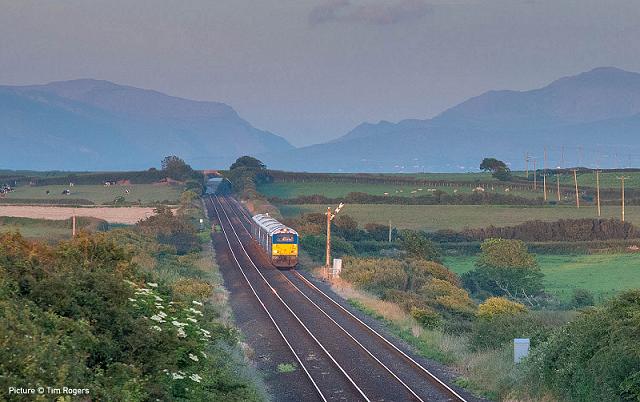
As the sun sets on 16 June, 67 001 passes Ty Croes down distant signal with the Cardiff - Holyhead express. Picture by Tim Rogers.
This is a 'Picture Extra': don't miss the 16 June Issue
Compass to Carlisle
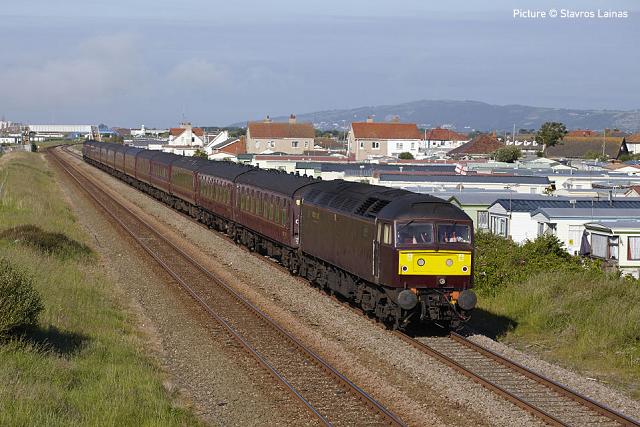
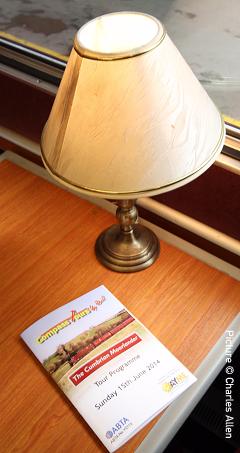
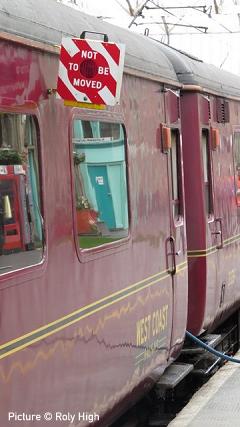
When Compass Tours run their excursions for the people of North Wales, it is necessary to move the locomotives and rolling stock to Holyhead beforehand, usually the previous day. In the case of the Father's Day special to Carlisle booked for Sunday 15 June, the train was provided by West Coast Railways and travelled on 14 June from their Carnforth base. Enthusiasts thus get two chances to take pictures - four if you include the locomotive on the rear. Stavros Lainas photographed the 14 June 'empty stock' (ECS) (above) near Abergele & Pensarn station, with locomotives 47 746 leading and 47 786 Roy Castle OBE trailing.
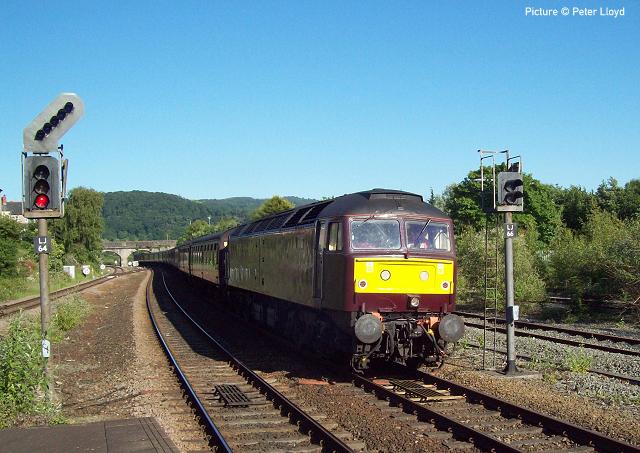
Llandudno Junction (Peter Lloyd.)
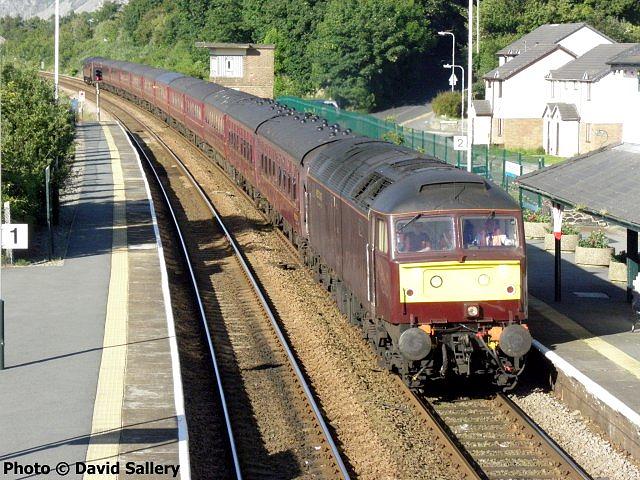
Penmaenmawr (David Sallery). The signalbox here is of an uncommon design, an early all-brick version designed by British Rail's London Midland Region, before their more common 'Type 15' versions made wholly of partly of timber. It has an unusual origin, on which we can quote the marvellous signalbox.org website:
A serious accident occurred here in 1950 where the 'Irish Mail' collided with a locomotive standing on the Up Main which the signalman had thought was in the sidings. The conclusion of the public enquiry was that the signal box, which had been in operation since the 1880's, was not suitably positioned as it was at the far end of the station and the signalman's view was obstructed by the station footbridge. Accordingly, a new box was built immediately opposite the yard connections at the east end of the station.
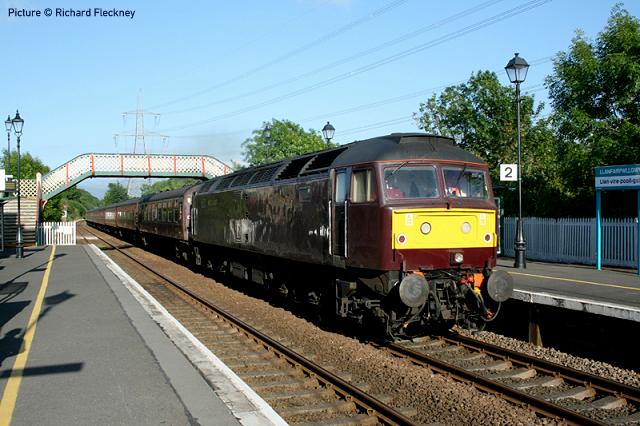
Llanfair PG (Richard Fleckney)
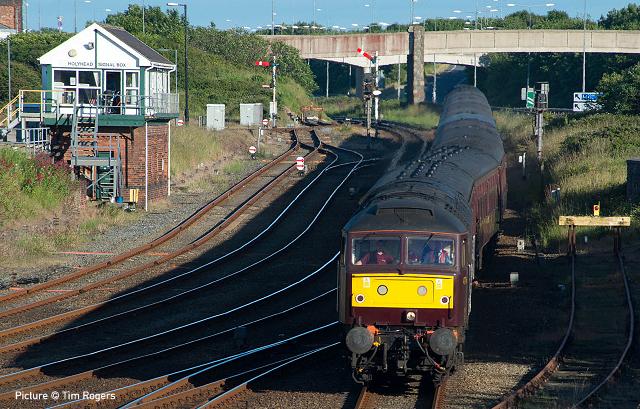
At Holyhead in the evening sunshine (Tim Rogers). The train was 5Z65 13:40 Carnforth Steamtown - Holyhead.
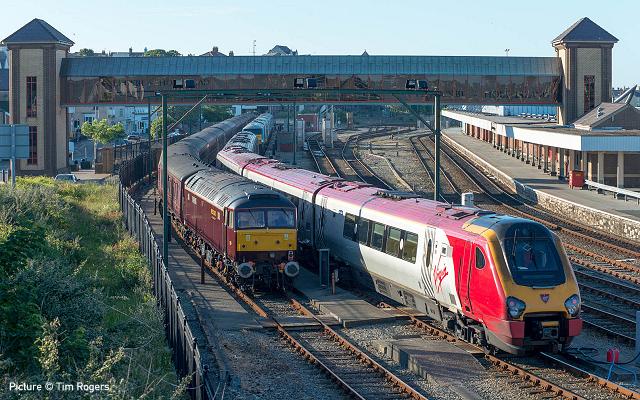
Stabled for the night in Holyhead carriage sidings; 47 786 at the eastern end of the train, with 221 104 Sir John Franklin alongside, having arrived on a train from London (Tim Rogers).
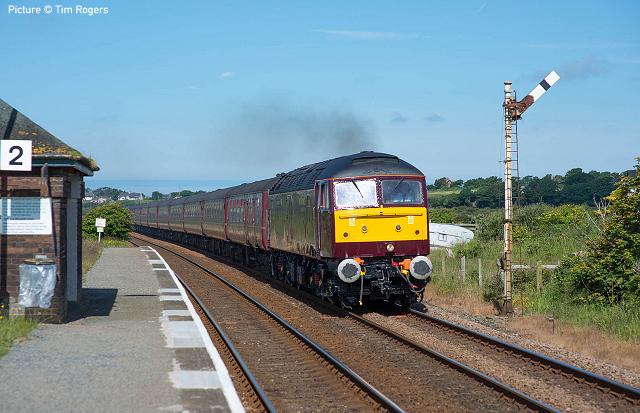
Next morning, Sunday 15 June, and the train heads out, led by 47 786, on its passenger duty, 1Z66 09:43 Holyhead - Carlisle, through Ty Croes with its 'staggered' platforms (Tim Rogers). The signals here protect the level crossing.
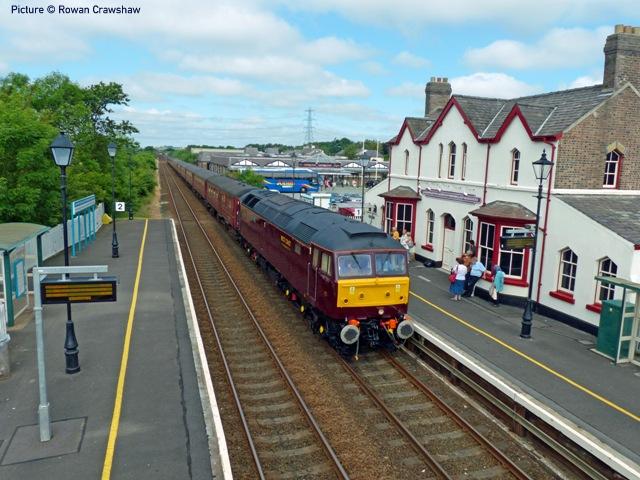
Llanfair PG (Rowan Crawshaw). Signs in old and new styles represent the station's full 58-character name. Arriva's version also includes a pronunciation guide.
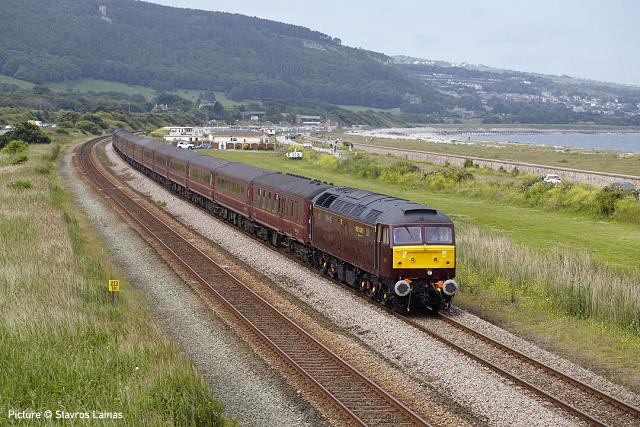
Near Abergele, 213¾ miles from London Euston (Stavros Lainas)
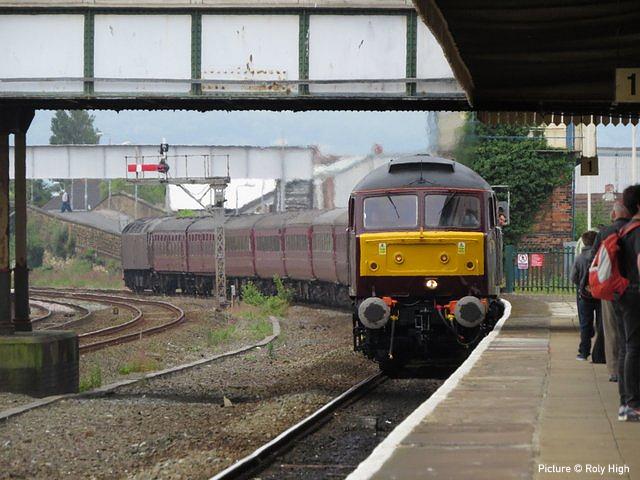
Rhyl (Roly High). The waiting passengers seem to be more interested in something outside the station.
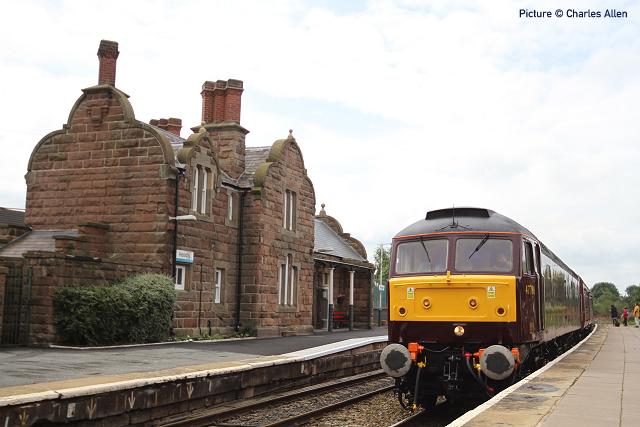
The train picked up at Helsby station where there was good turnout (Charles Allen). Compass Tours will be moving their offices into the recently-renovated Helsby station buildings next year. Owner Kevin Melia told the local press: '“Compass Tours has been organising days out and short breaks by rail for over a decade now and is looking forward to relocating its current offices to Helsby Railway Station, which will see the opening of a community travel centre and small waiting room facility.
'The site was chosen as it was deemed perfect by the business for its location in the region and our ambitions to find an opportunity to develop a facility both useful to the community and to enable Compass to diversify more from its current activities.'
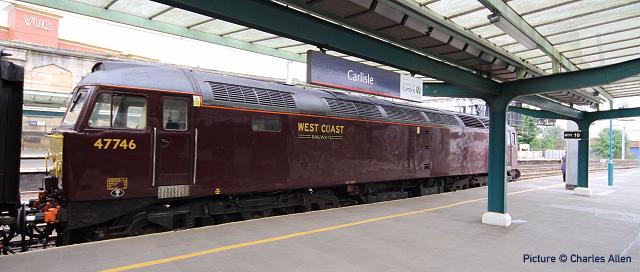
Carlisle (Charles Allen). The train carried invited
guests from the North
Cheshire Rail Users Group and Arriva Trains Wales.
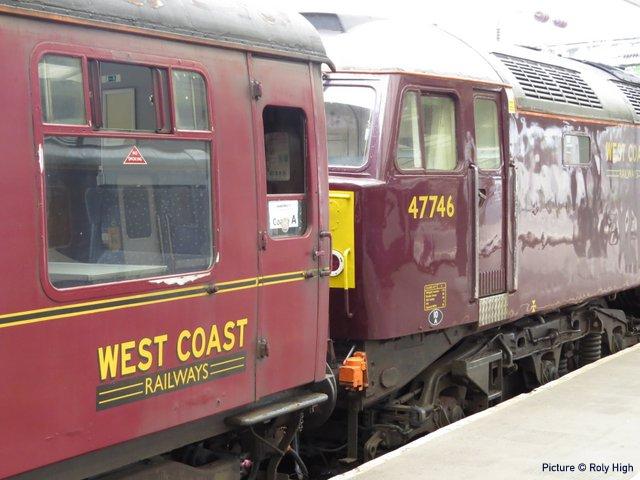
The outward journey travelled via the West Coast Main Line over Shap
summit. 47 746, on the rear on arrival at Carlisle at 14:32, is
looking shiny, whilst the rear Mk1 coach looks a little tired (Roly
High).
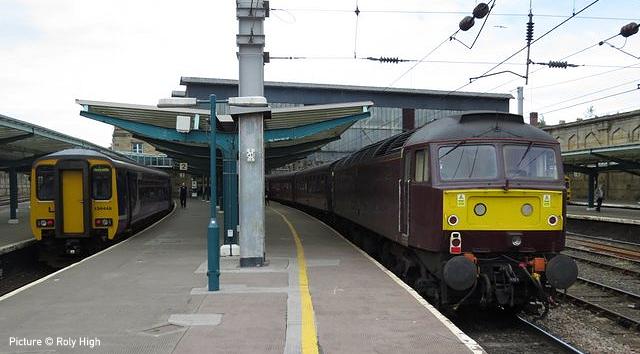
In platform 2 at Carlisle, Northern Rail 156 448 which would form a departure to Newcastle (Roly High)
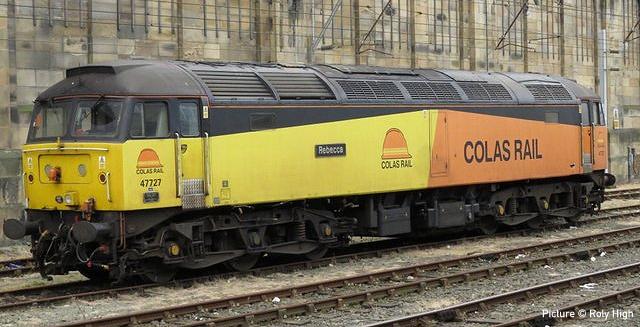
Stabled at Carlisle, Colas Rail 47 727 Rebecca (Roly High).
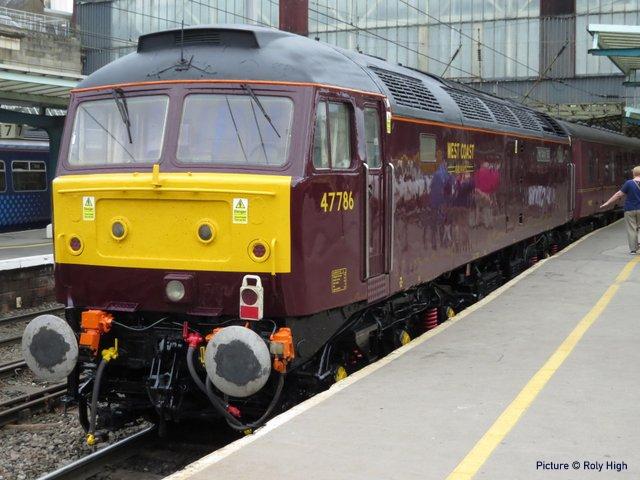
47 786 looking resplendent in its new coat of paint (Roly High).
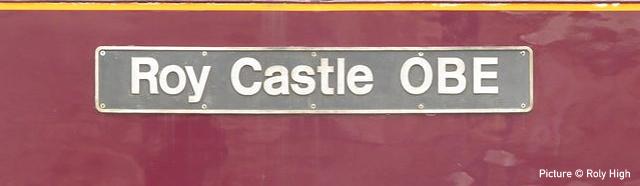
It is almost 20 years since the name was first applied to this loco, unveiled by Mrs Fiona Castle at Waterloo International on 22 July 1994 at the end of the 'Tour of Hope I' train which toured Britain raising funds for research into cancer, the disease which killed the well-known entertainer later that year. The Roy Castle Lung Cancer Centre was officially opened in Liverpool on 12 May 1998 and stands as his memorial.
At that time the loco was operated by 'res' - the Rail Express Systems parcels and mail sector, and the original nameplate was lettered in their corporate style of 'Frutiger' typeface. This was removed after privatisation, c. 1999, and the present ones in something like BR's Rail Alphabet were applied by West Coast Railways at an open day in their Carnforth depot on 26 July 2008. (Thanks are due to the superb Class 47 site.)
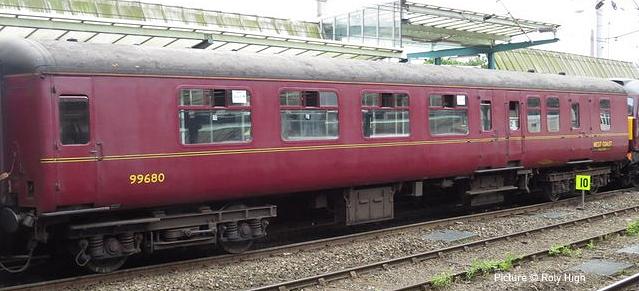
On the end of the train, Mk2a Brake First coach 99680, formerly 14102 and 17102 - a sister vehicle to the two discussed in the last issue (Roly High). The 99xxx number series was created for 'privately-owned' coaches registered for use on the main line, to distinguished them from British Rail-owned coaches. Today, of course, nearly all trains are privately-owned, and vehicles used by charter operators retain their BR-allocated number but West Coast have retained some of the 99 numbers. A certificate which can be found online (PDF) lists this one among all West Coast's fleet of 'slam-door' coaches which have been granted exemption to Railway Safety Regulation 5(1): 'No person shall operate, and no infrastructure controller shall permit the operation of any rolling stock on a railway if the rolling stock has hinged doors for use by passengers for boarding and alighting from the train (other than doors which have a means of centrally locking them in a closed position).'
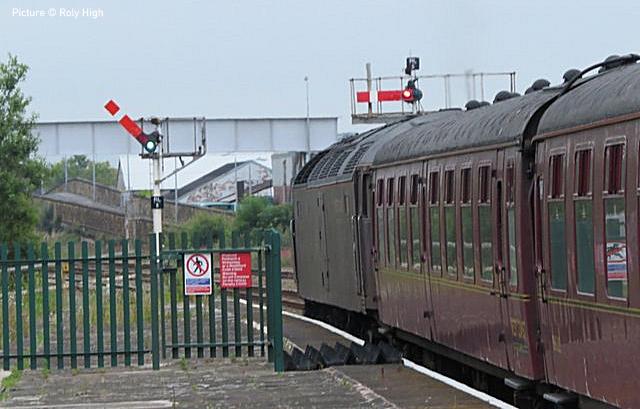
Smart work by the Compass Tours stewards and Carlisle's station staff, ensured the train was serviced ready for the return run in the limited time available before departure at 16:28 via the Settle-Carlisle line, Blackburn and Wigan. Above, 47 746 heads 1Z67 16:28 Carlisle - Holyhead at Rhyl, 21:09 (Roly High). The train ran within five minutes of its booked time throughout in both directions.
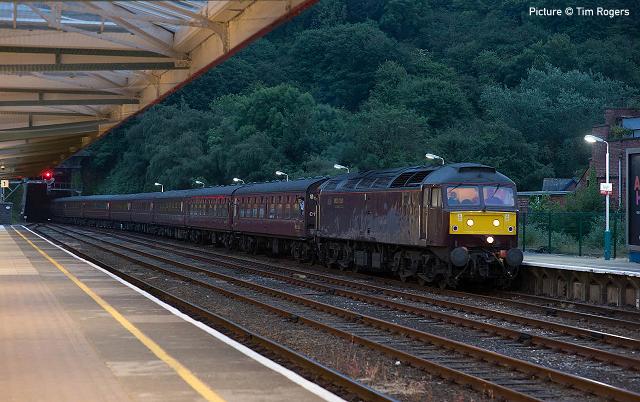
Evening arrival at Bangor, 21:51 (Tim Rogers). The train arrived at Holyhead at 22:24 and twenty minutes later headed back empty as train 5Z68 to Carnforth, arriving at 02:41.
Out and about - with Stavros Lainas
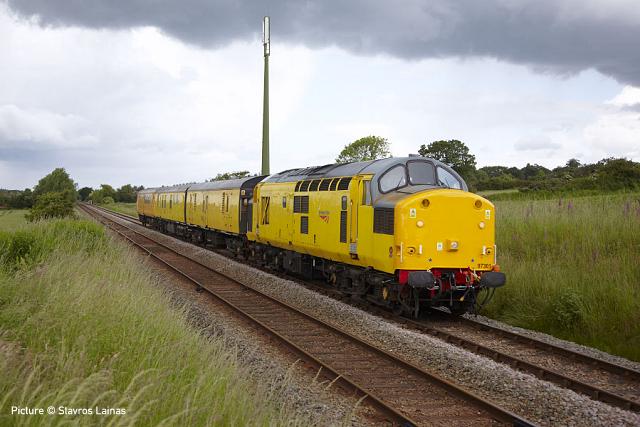
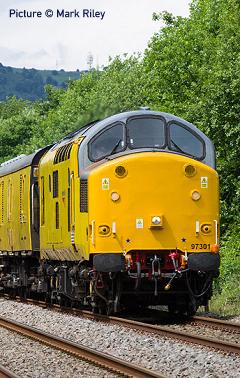
Some pictures in the recent summer weather. The first (above) is from 10 June, the Ultrasonic Test Train on the Bidston - Wrexham line at Burton Point on the Wirral with 97 301 leading. Passed me at 13:34 shortly before the heavens opened ...
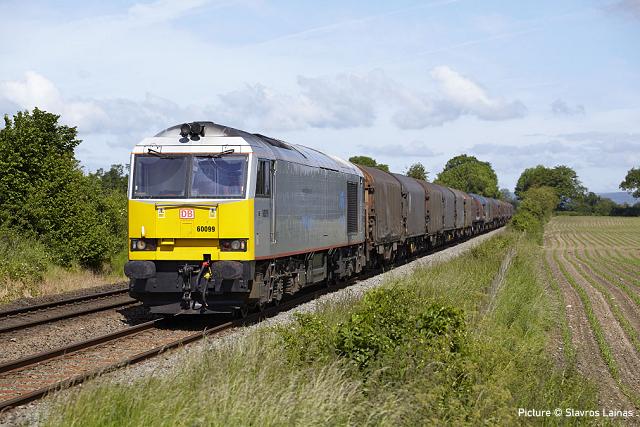
The following day, 11 June, the weather was much better as I shot the morning southbound steel train with 60 099 just south of Gobowen at 10:23.
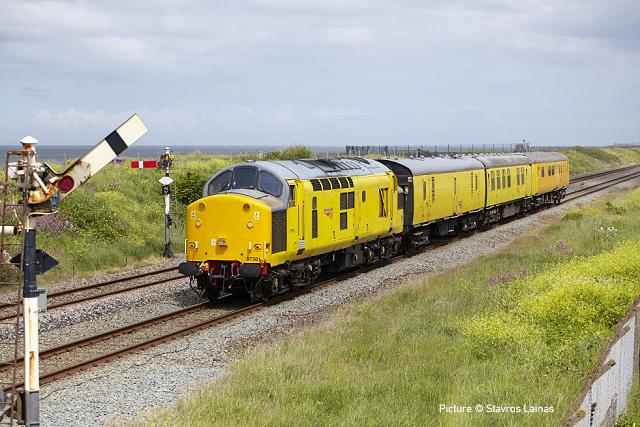
Later that day I travelled to Abergele for 97 301 on its working along the coast. It passed me at 13:55.
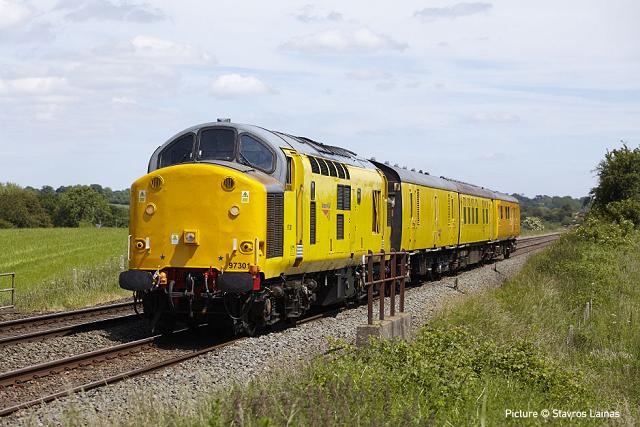
On 12 June I again managed again the Test Train, this time at Beeston (between Crewe and Chester) at 13:45.
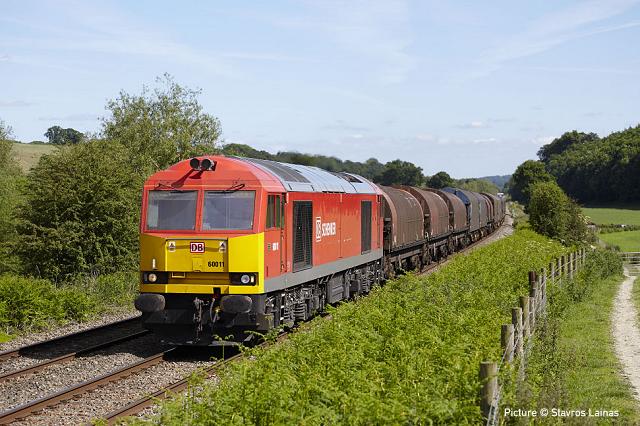
With the weather so nice I couldn't miss an opportunity to shoot a northbound steel with a class 60 on it so I headed to Craven Arms. where 60 011 passed at 17:00.
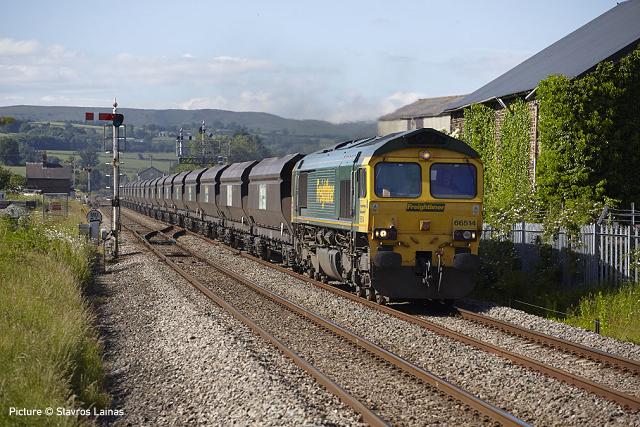
Next shot is of 66 514 on the Fiddlers Ferry - Portbury Dock empty coal hoppers, running 20 minutes early, again at Craven Arms.
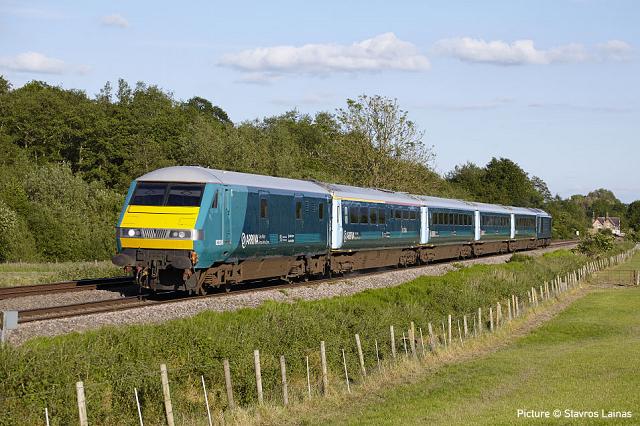
Spent the next hour having a pub lunch before heading just down the line at Onibury to photograph the evening Cardiff - Holyhead 'WAG Express' at 18:54 ...
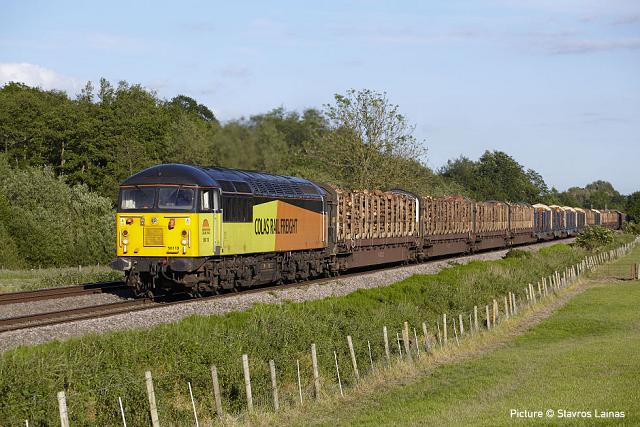
... and the north bound timber to Chirk from Baglan Bay at with Colas 56 113 at 19:20 I could hear the thump - thump - thump from Ludlow!
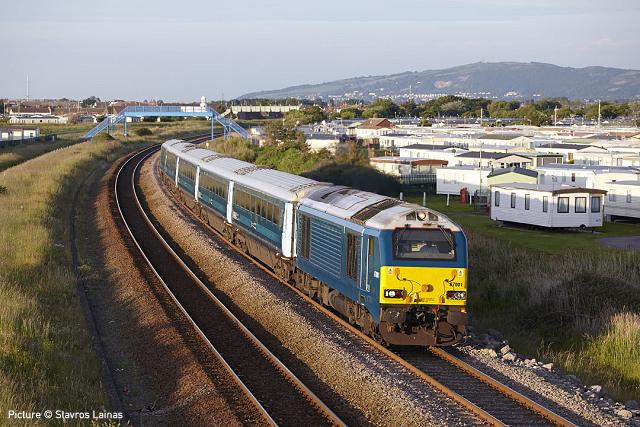
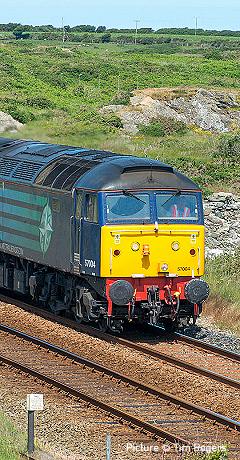
June with its long days is the best time to photograph the Cardiff - Holyhead express on the Coast line. This is Towyn at 20:40 on 17 June, with 67 001 leading.
Flasks
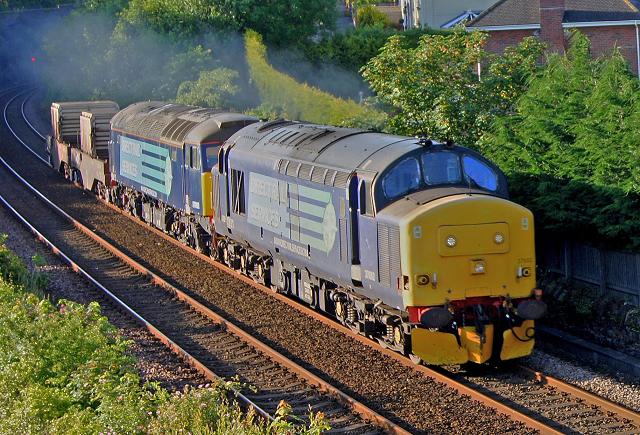
Wednesday 11 June, and 37 682 and 57 002 with two flasks for Valley head west at Bridge 118 - the footbridge just out of Conwy by the new houses and before the bridge over the 'old' Main road (Peter Basterfield).
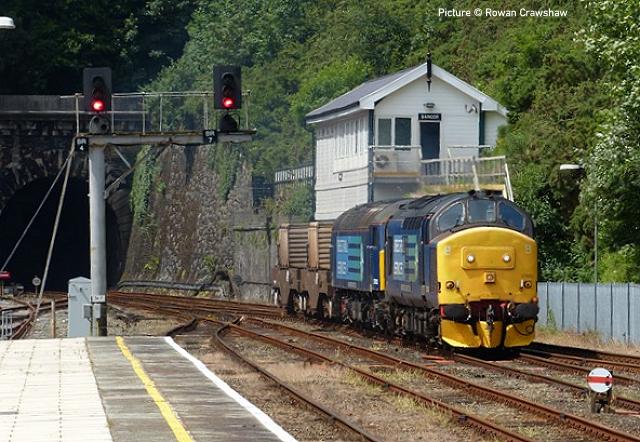
The return 6K41 service, 110 minutes early, passes Bangor (Rowan Crawshaw).
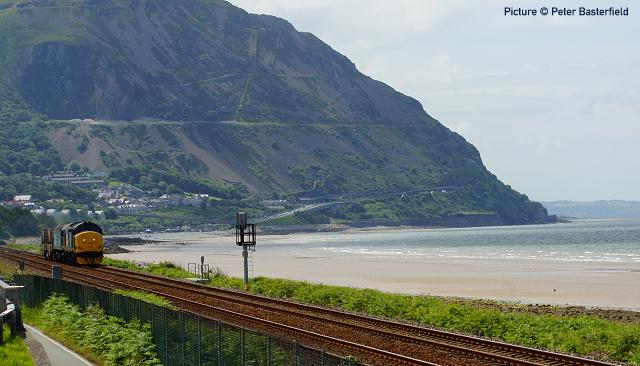
Approaching the footbridge at Penmaenmawr (Peter Basterfield) ...
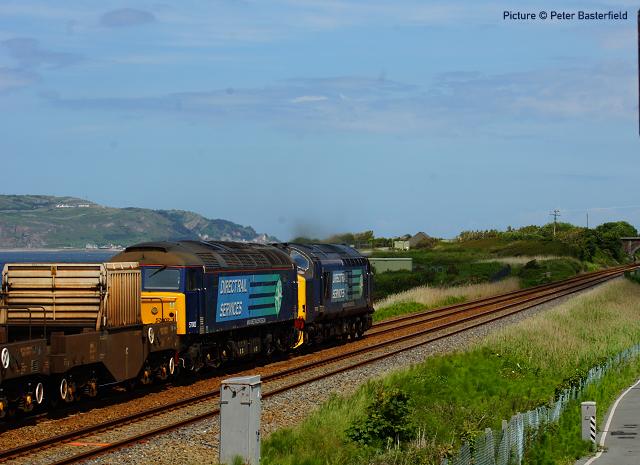
... and heading off towards Conwy.
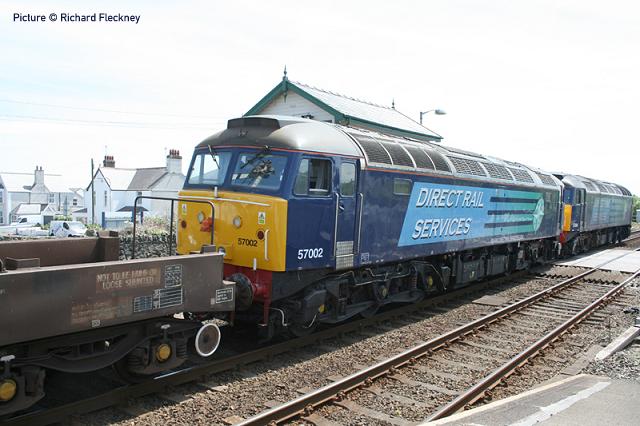
On Monday 16 June, 57 002 and 57 004 reverse out of Valley sidings with their single flask for train 6K41 to Crewe (Richard Fleckney).
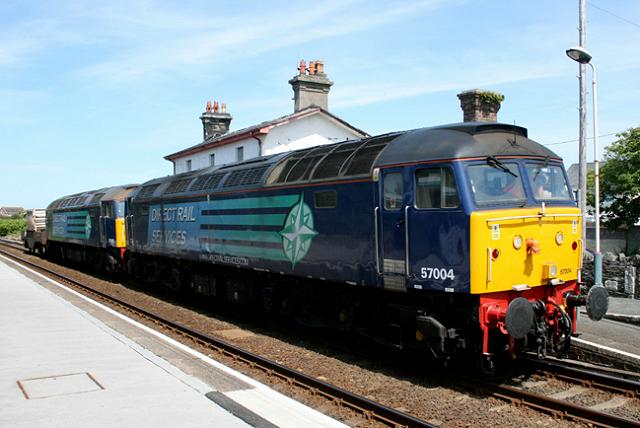
Waiting in Valley station for the run to Crewe which 57 004 will lead (Richard Fleckney)...
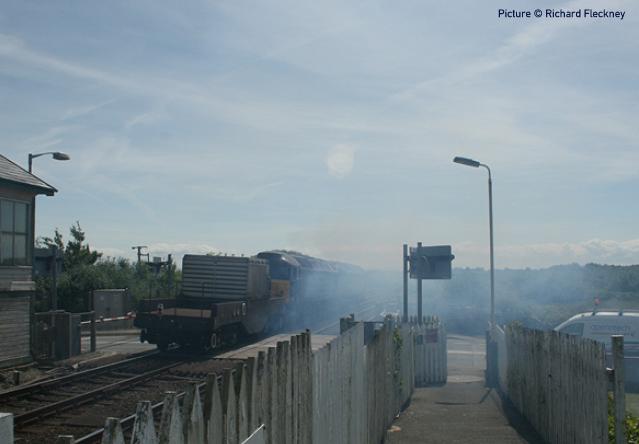
... and away, clearing the exhaust build-up (Richard Fleckney).
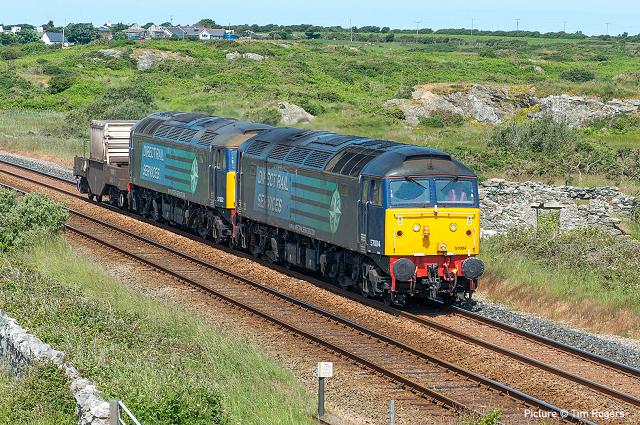
57 004 and 57 002 pass RAF Valley with the 6K41 Valley to Crewe flasks on 16 June, running 156 minutes early (Tim Rogers).
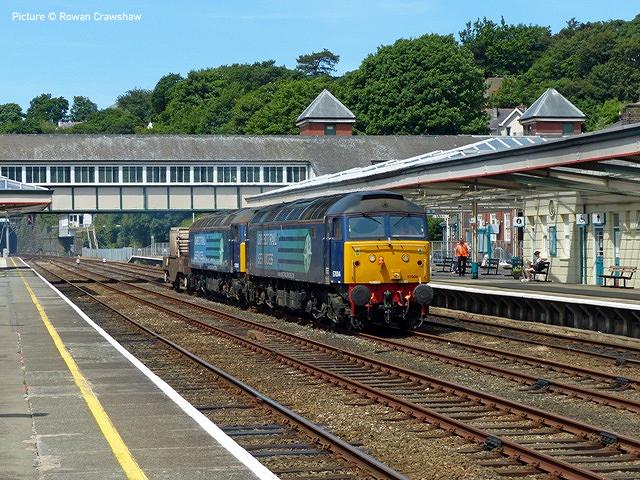
Bangor (Rowan Crawshaw).
Ultrasonic Test Train scenes
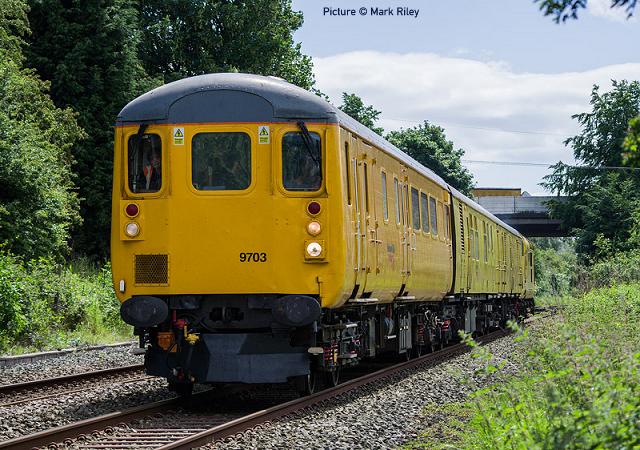
On 10 June driving trailer 9703 heads the Ultrasonic Test Train towards Gwersyllt on the Borderlands line with 97301 propelling at the rear (Mark Riley).
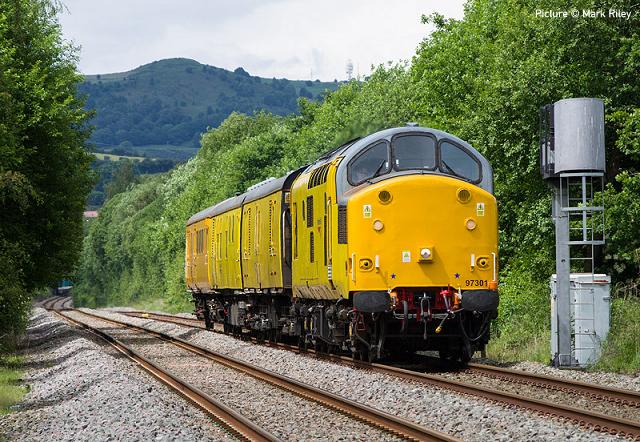
Returning from its afternoon trip to Bidston, 97 301 leads the train up the bank from Gwersyllt towards Wrexham (Mark Riley).
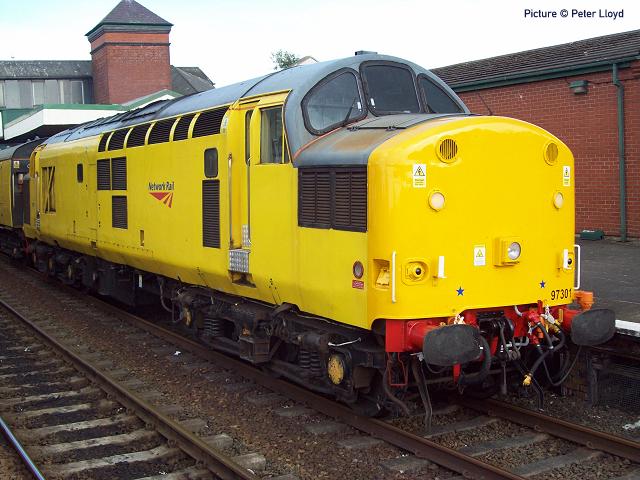
Portrait of 97 301 working the 3Q01 12:12 Crewe C.S. to Crewe C.S. Ultrasonic Test Train on 11 June, after returning from Blaenau Ffestiniog it paused in Platform 4 at Llandudno Junction (above) while the driver took his ' 'Personal Needs Break' before heading to Bangor. Picture by Peter Lloyd.
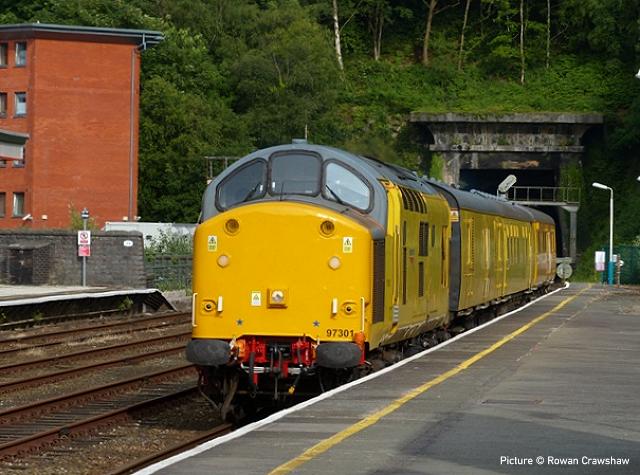
97 301 arrives at Bangor (Rowan Crawshaw). Ultrasonic technology is used to locate any faults in the rails.
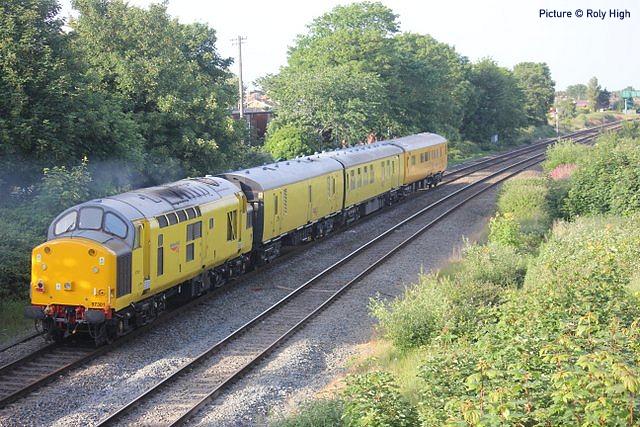
Returning through Rhyl, driven from the Driving Trailer (Roly High). Of the four locos refurbished for use with the ERTMS signalling on the Cambrian lines, 97 301 was not initially fitted with the equipment, but in 2013 it was fitted with Hitachi-made equipment, to prove 'interoperabiity' with the Ansaldo system fitted to the Class 158s and 97 302 - 304 and in the control centre.
Seeing double at Rhyl
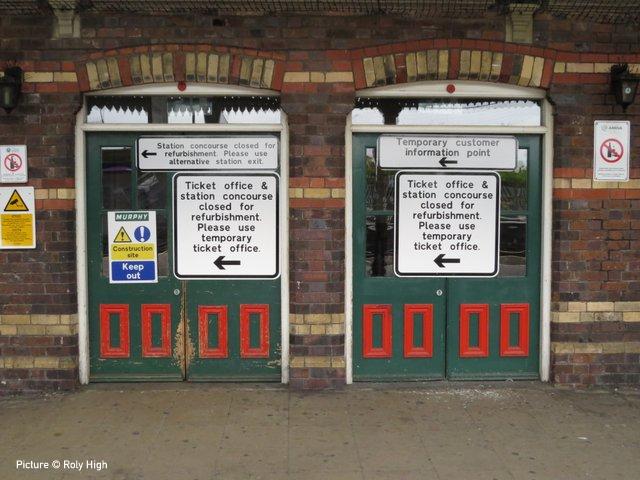
Passengers can be in no doubt that the booking office and concourse at Rhyl are closed for refurbishment. Picture by Roly High.
North Wales Coast home page | Archive | Previous Notice Board