NORTH WALES COAST
RAILWAY :NOTICE BOARD
Rheilffordd arfordir gogledd Cymru: Hysbysfwrdd
Updated
17 August
next update
31 August




See our Calendar Page for operator details.
Llandudno Museum, as part of the Rail200 celebration, has some rail related talks which may be of interest to readers. All are for approximately one hour starting at 1300, at the museum, 17-19 Gloddaeth Street Llandudno, LL30 2DD
4 August – Past, present and future of railway heritage in Wales – Dr Louise Moon (Transport for Wales)August 2026
11 August – Station Masters, Agents and Tickets – Philip Evans
27 August – History of British Transport Police – Bill Rogerson MBE (Secretary of BTP History Association)
Saturday 1 August Northern Belle "Penderyn Distillery, Conwy Castle Or Llandudno At Leisure", Hull to Llandudno Junction. WCRC 47/57.
Sunday 15 August Railway Touring Company "The Slate Miner", Oxford to Blaenau Ffestiniog. WCRC 57 to Bescot, with a Colas Rail 56 to Blaenau Ffestiniog and return
Wednesday 19 August Midland Pullman "Torbay Riviera Pullman", Chester, Wrexham General, Ruabon, Chirk to Torquay and Paignton. LSL Midland Pullman HST.
Saturday 22 August SPRS Railtours "The Thistle & Dragon" Leven to Llandudno. LSL 50050 Leven to Llandudno and Llandudno to Chester. 45118 from Chester to Leven.
Saturday 22 August Retro Railways 'The Retro Cestrian Bard' Class 37s from Stalybridge to Stratford-upon-Avon and return. Pickup:
Stalybridge 07:00
Reddish South 07:15
Stockport 07:25
Altrincham 07:40
Knutsford 08:00
Northwich 08:15
Chester 08:50
29-31 August 2026 Bala Lake Railway Steam Gala
September 2026
19-20 September Bala Model Railway Show
Thursday 3 September Clwyd Railway Circle "Severn Valley Steam" Highlights of 2012 and 2013 Steam Galas - Glyn Jones
Saturday 19 September Northern Belle "Settle & Carlisle Steam Special", Wrexham General and Chester to Carlisle. WCRC steam locomotive over the Settle & Carlisle line. Diesel hauled otherwise.
October 2026
Thursday 1 October Clwyd Railway Circle 'The view from a signal box window' Adrian Bodlander
November 2026
Thursday 5 November Clwyd Railway Circle "40 years of Railway in the Chester area" - Geoff Morris
December 2026
Thursday 3 December Clwyd Railway Circle Ian Mainprize 'German Railway Development'
Friday 8th January Jeremy Nicholls "100 Years of Trains to Audlem" and "Nantwich and the Railway".
Friday 12th February Chris Davies "The AERPS and the Last Years of the 1500 volts dc Altrincham Electrics". Chris is a Vice-President of the Society and he has been involved since the early days in the early 1970s.
Friday 12th March Paul Shackcloth "People and Places 9". More images of the pre-1968 steam railway with at least one person visible.
For up-to-date North Wales information
join the North Wales Trains News group
North Wales Coast Railway website created and compiled by Charlie Hulme
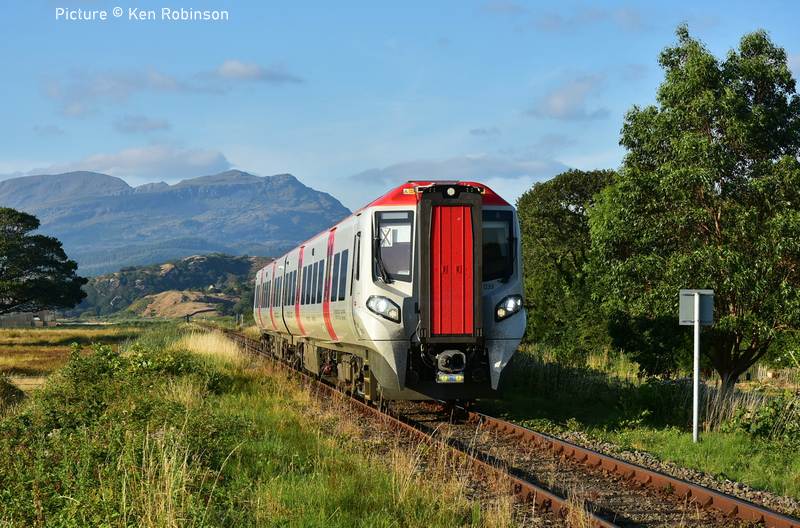
197 039 passing Talsarnau with 3C07, the 18:35 Pwllheli - Machynlleth on 24 July 2026, on staff training duties. These units should be entering service in the near future. Picture by Ken Robinson.
TfW troubles - Press Release 14 August
Due to industrial action in its supply chain and a subsequent maintenance backlog, TfW will have a reduced number of trains available for service from Monday 17 August. To provide a consistent service for passengers, TfW will be making some pre-planned service alterations to services from Monday. Changes include:
Rail replacement services on the Conwy Valley line throughout the week.
Withdrawal of the Chester – Wrexham and Crewe – Shrewsbury local rail services due to reduced numbers expected on these routes with significant engineering work taking place for two weeks. Replacement buses will be in place.
Other services across the network are planned to run but may be subject to short-notice alterations or reduced capacity.
News Pictures
Note: Items that arrived close to the update time will be used next time, as I am busy preparing for a holiday. On TfW unfortunately - Charlie
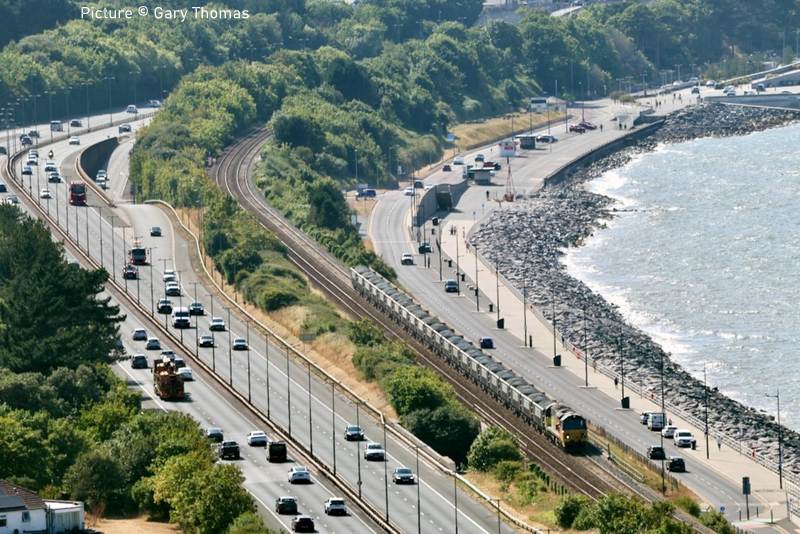
20 July: Loco 70 801 takes a load of stone from Penmaenmawr from Llandudno Junction to Chaddesden Sidings seen above Old Colwyn. Some loads of stone trains have been starting at Llandudno Junction, brought by road from Penmaenmawr. (Gary Thomas).
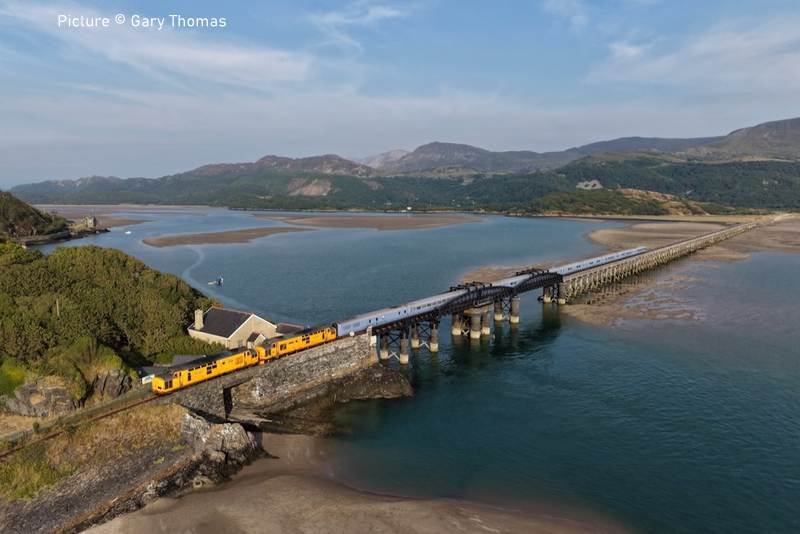
On 21 July 97 304 and 97 303 cross Barmouth Bridge with Belmond Britannic Explorer from Llandrindod Wells to Barmouth (Gary Thomas)
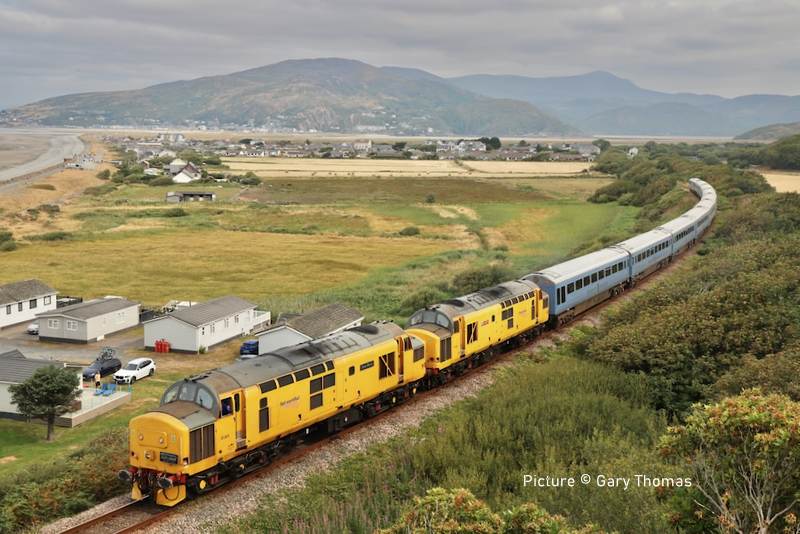
The next day, the returns past Friog Rocks on the way from Barmouth to Machynlleth (then Morton-on-Marsh) (Gary Thomas)
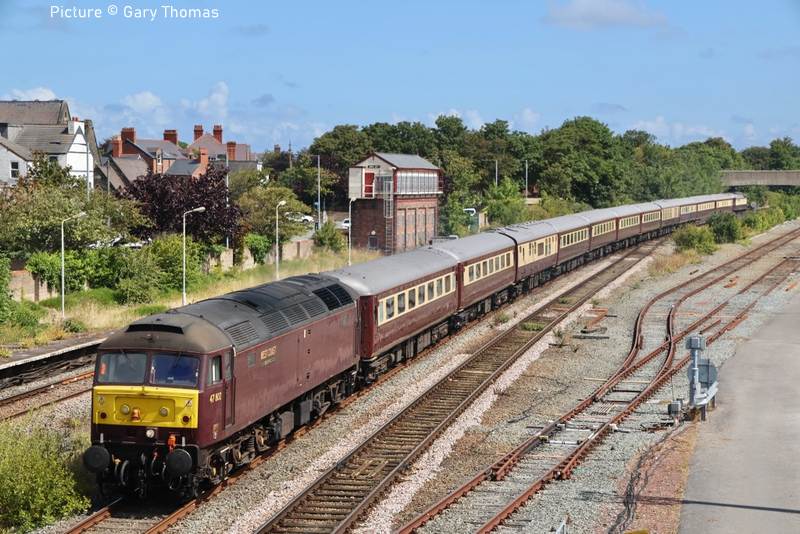
On 1 August 47 802 passes Rhyl engineering sidings with a 'Northern Belle' luxury excursion from Hull to Llandudno Junction. 57 601 was on the tail. (Gary Thomas).
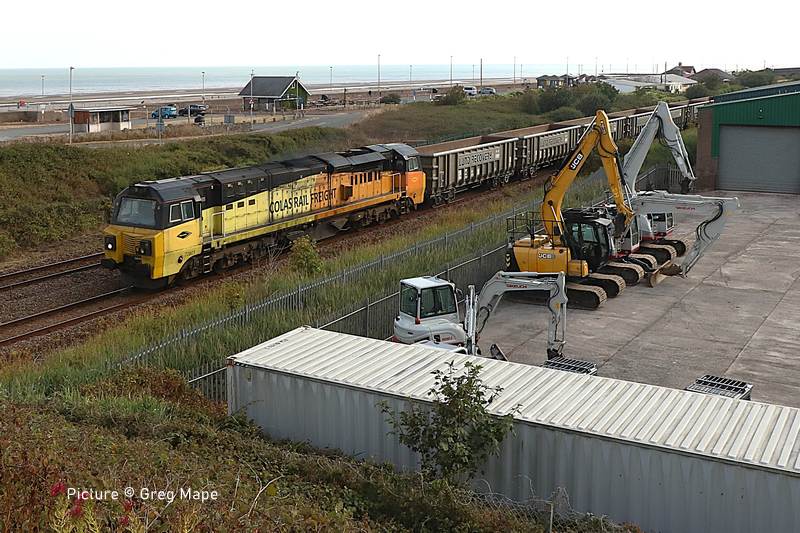
70 801 comes back for more: Bradwell Up Sidings to Llandudno Junction. Seen passing Abergele and Pensarn on 3 August. (Greg Mape)
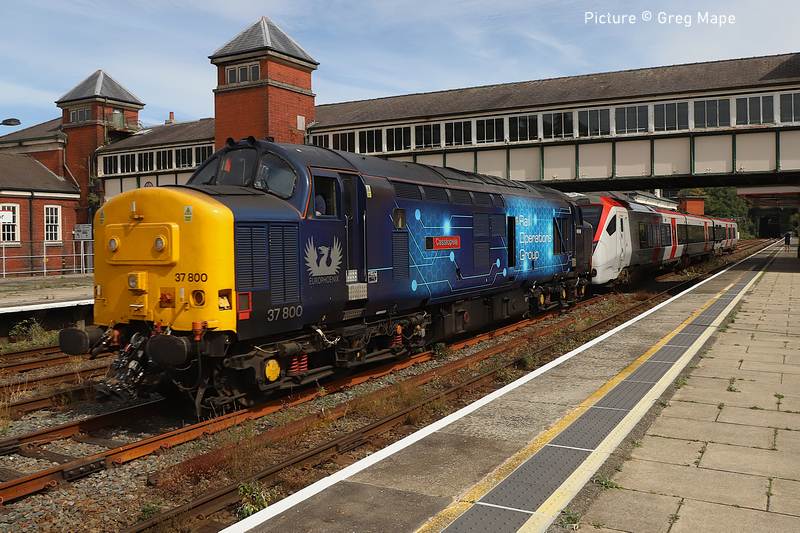
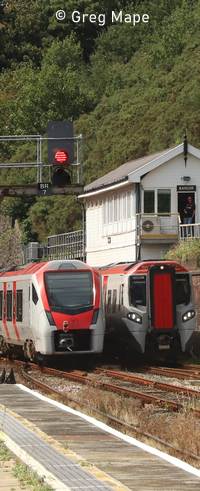
37 800 Cassiopeia hauling 'Flirt Unit' 756 007 through Bangor Station on 10 August
as 5Q40 09:50 from Cardiff Canton Sidings to Holyhead Depot. for wheel turning. also passing 197 102 heading to Cardiff from Holyhead (Greg Mape). Interestingly 37 800 is one of the five Class 37 locos went to Spain helping to build the AVE (Alta Velocidad España) high speed network from 2001 to 2011. It was returned to Britain in August 2012.
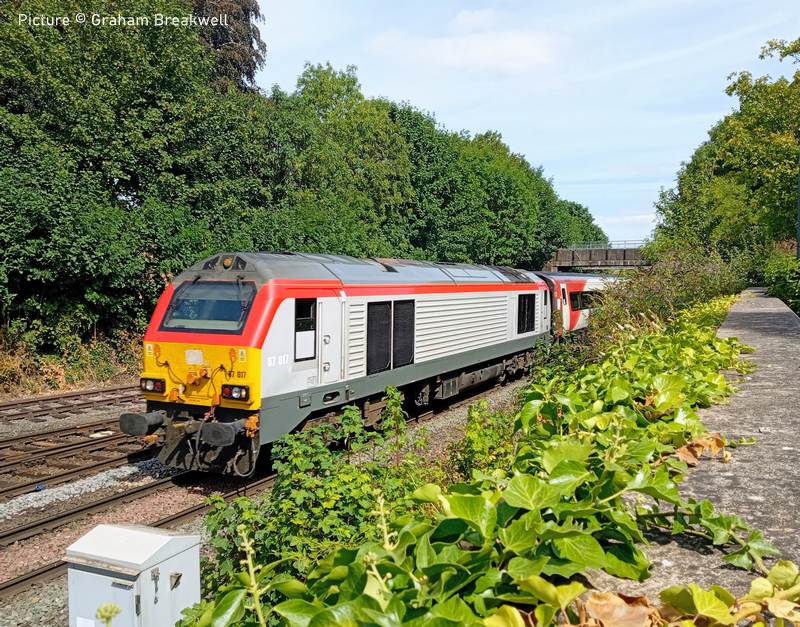
On 10 August 67 017 working 1V39, the 10:30 from Manchester Piccadilly to Cardiff Central passes Sutton Bridge Junction. (Graham Breakwell).
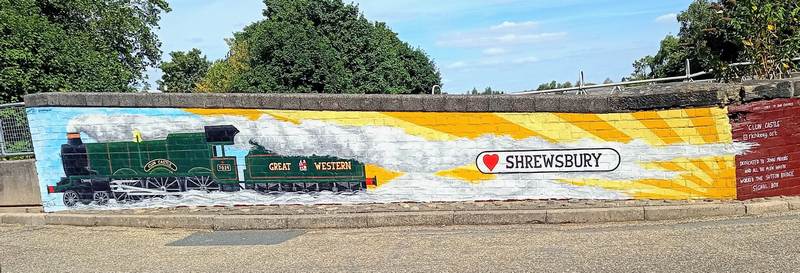
A mural that has been created on the parapet of Sutton Bridge by a local artist - 7029 Clun Castle and a dedication to the signalmen working at Sutton Bridge Junction box. (Graham Breakwell).
The Crewe Works Test Train - an enquiry by Daniel Pearson
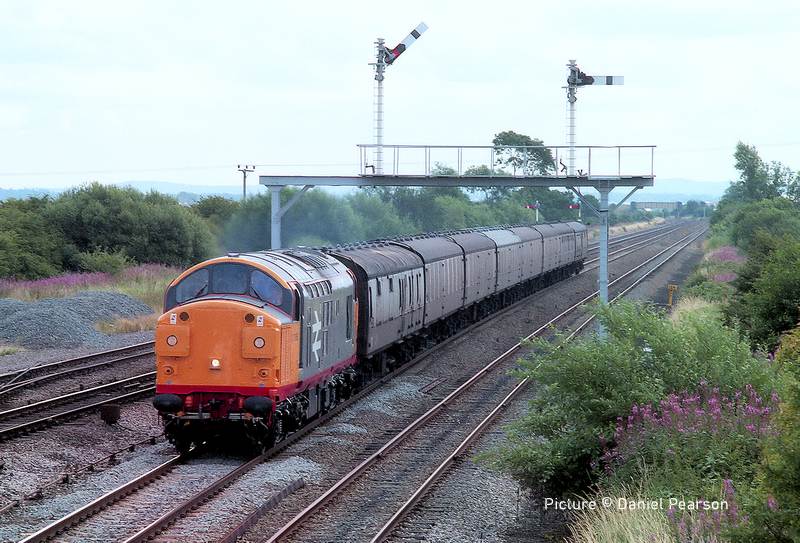
I'm wanting to model the Crewe Works Test Train at it was from the mid to late 1980s and I'm looking for photos of the individual coaches so I can get details such as numbering & position etc. While there are several pictures of the train available in the usual loco-first three-quarter view on the internet there are surprisingly few of the coaches themselves. I've attached my own picture of the train taken at Sandycroft in August 1987 hauled by 37 068.
For readers reference these were the numbers and types of coaches involved:
ADB975618 QXV - ex MK1 BSK M34359
ADB975626 QXV - ex MK1 BSK S34939
ADB975627 QXV - ex MK1 BSK S34938
ADB977081 QXA?- ex MK1 FK M13267
ADB977148 QXV - ex MK1 CK M16133
ADB977149 QXV - ex MK1 CK M16137
ADB977150 QXV - ex MK1 CK E15642
ADB977151 QXV - ex MK1 SK M25339
ADB977326 QXV - ex MK1 CK M16138
ADB977327 QXV - ex MK1 CK M16114
Write to us at the website if you think can help Daniel.
Miscellany
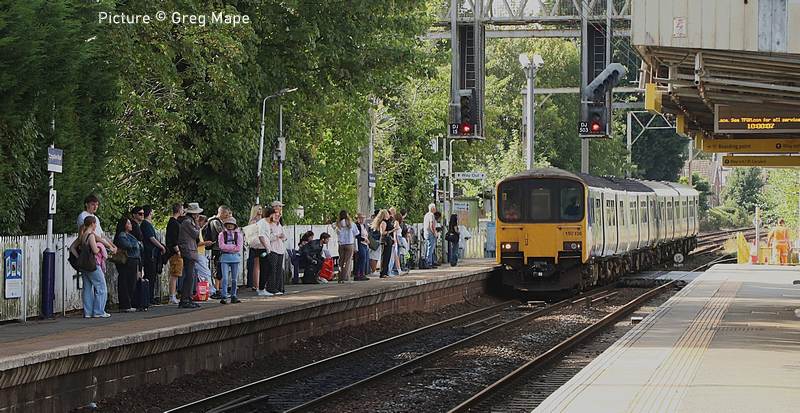
Early in August the Manchester - Altrincham section of Metrolink was closed for engineering work, creating extra traffic on the Manchester - Chester line. On 1 August the small station at Navigation Road saw the arrival 08:56 Chester - Manchester Piccadilly arriving formed of 150 136 and 150 133 It isn't on the wrong line - the rail station is single track here, the other line is for trams.
Out of interest: 150 136 is the one that was - slightly modified on the front end to carry an experimental device. The idea was that trains in passenger use would have 'advanced sensors to monitor track and infrastructure in real time.' It was was soon removed. There's information here.
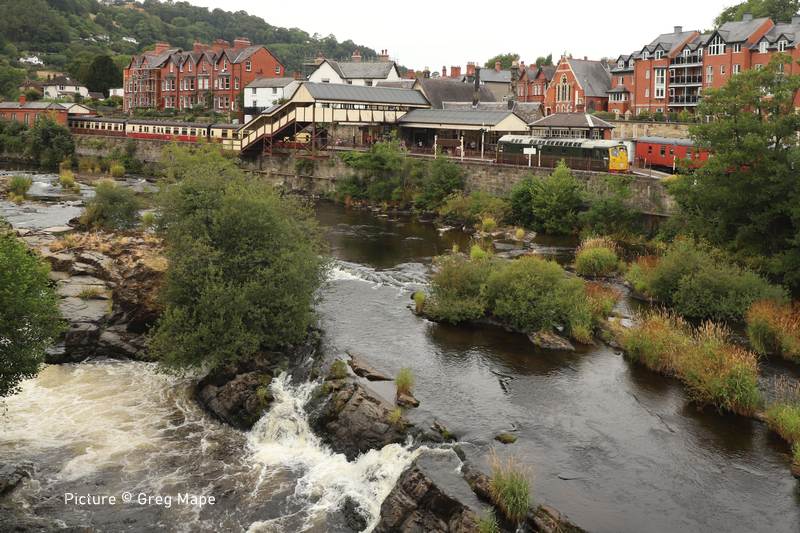
A scene at the Llangollen Railway 1960s weekend, 2 August 2026. The loco is 26 010 (5310) (Greg Mape).
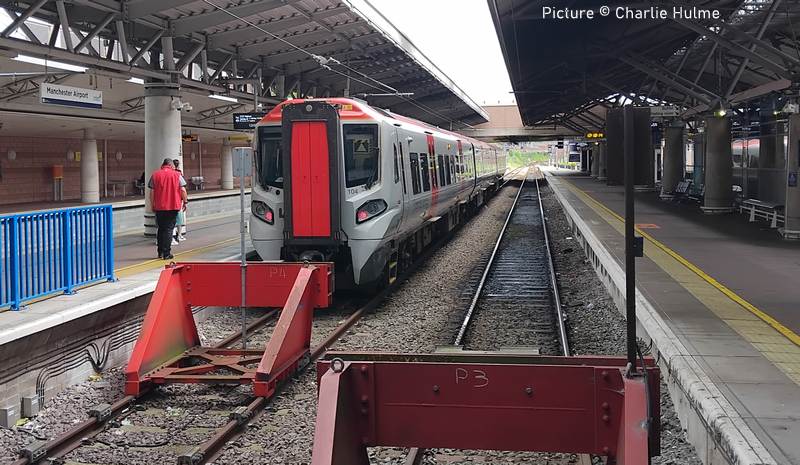
Manchester Airport station on 2 July, 197 104 and a sister have arrived with the 09:05 From Holyhead, returning as the 12:15 to Holyhead. These trains generally used this platform, no.4, adjacent to Metrolink's line which makes a very slow journey to Manchester. Who can get a picture Train and Tram in the station together?
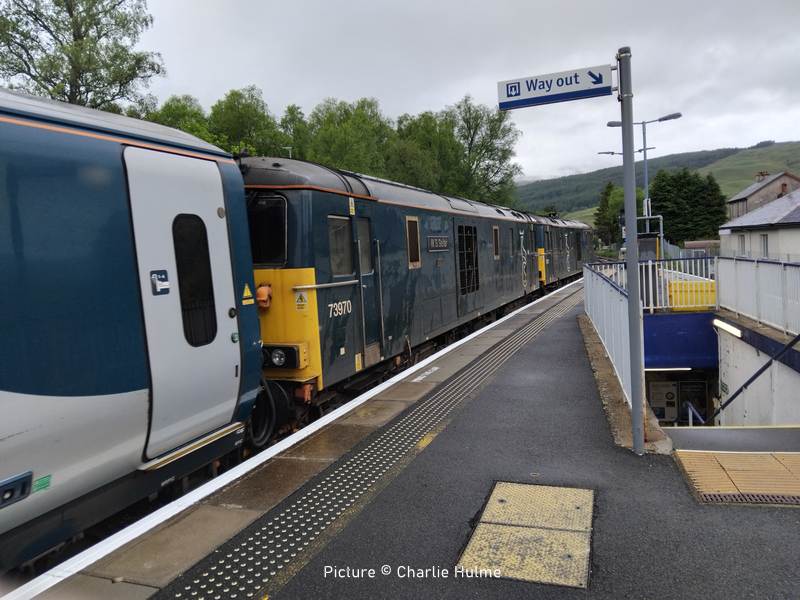
What I did on my holiday (and won't do again). Charlie and Joanna thought we should try the Caledonian Sleeper from Crewe to and Crianlarich then ordinary train on to Oban, our destination. The timetable shows that the Scotrail Oban train leaves Crianlarich at 07:18 and the Sleeper arrives at 07:48. The next train to Oban is two hours later
Still we were keen to try the new rolling stock : 'Our Club En-suite rooms offer a private space where you can relax .... before drifting off in comfort to snooze your way to your destination'. What we got is a space so small at there is no room to swing a kitten, and the the door of the En-Suite had a broken door which swung about all night with no way to shut the door. The coaches are by CAF, so riding is rough, and the ladder to the top berth is vertical and fixed position, unlike those on many of the sleeping cars we've used around Europe. Passengers have been releasing the ladder, so the company has had to use special screws and put up a sign. We didn't sleep at all. Be warned.
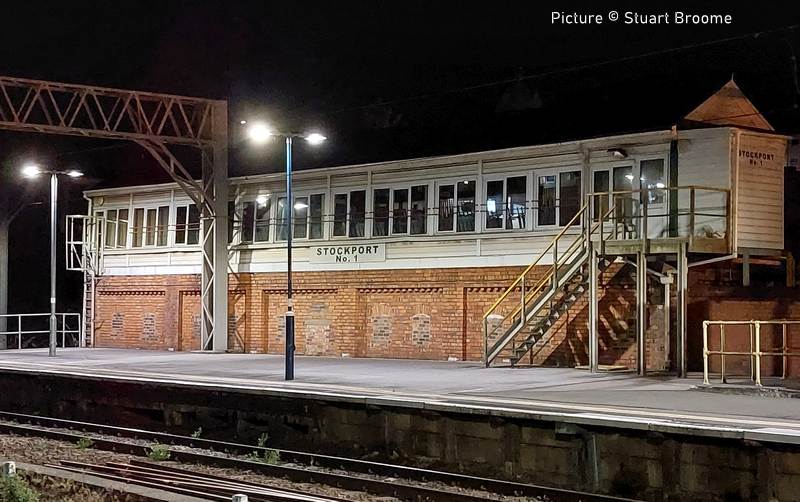
Two pictures of Stockport station taken by Stuart Broome on the late evening of 8 August. Above, Stockport No.1 Signalbox, built in 1884 and still in action, although many on its 96 levers are now redundant.
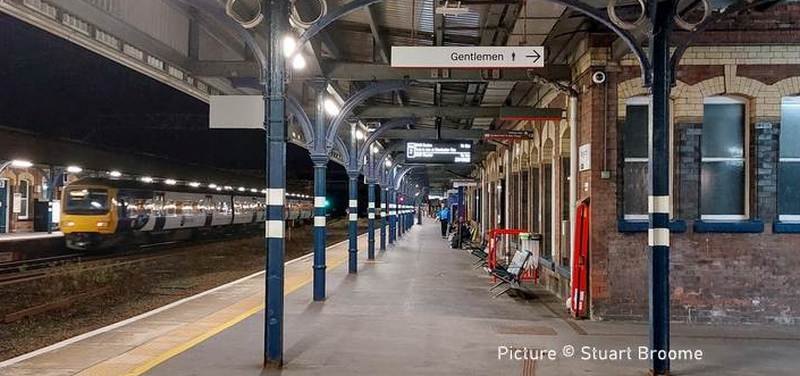
Across the station with 323 210 2H87 22:17 Stoke-on Trent to Manchester Piccadilly in Platform 3.
From Dave Sallery's Archive
An 80s extravaganza !
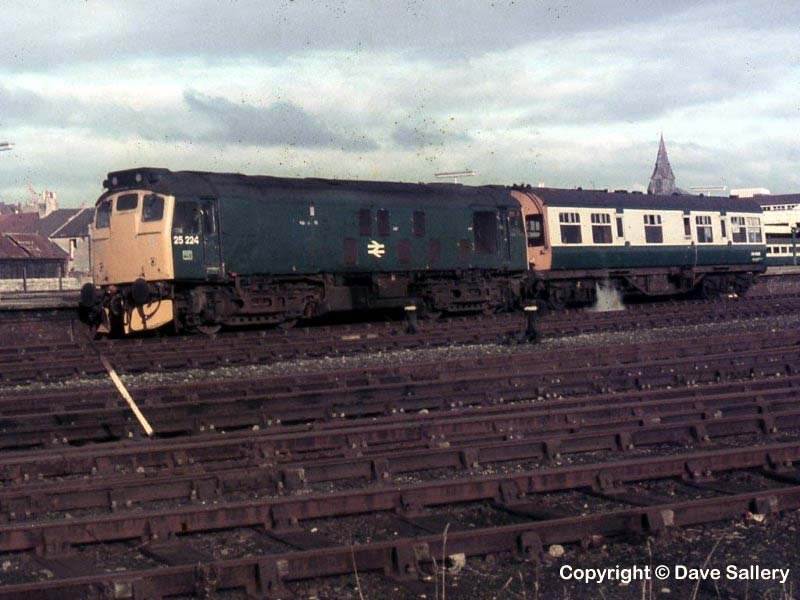
25 224 on an inspection train in Rhyl yard, 24 October 1983. Note the tell tale-sign of steam heating.
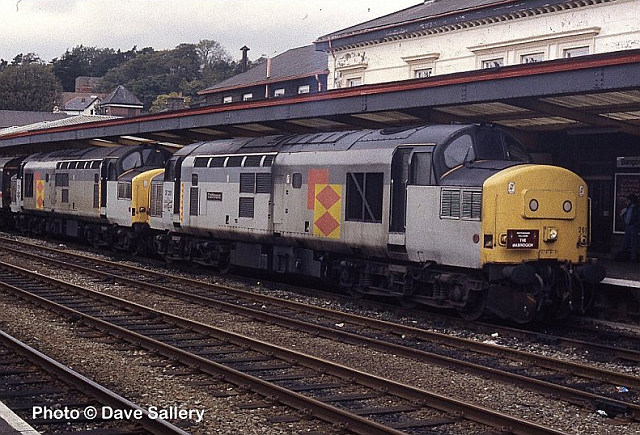
37 218 and 37 261 in Bangor after arriving from Amlwch while working 'The Mabinogion', 16 October 1983. The tour was from Euston and 47 513 was on the rear.
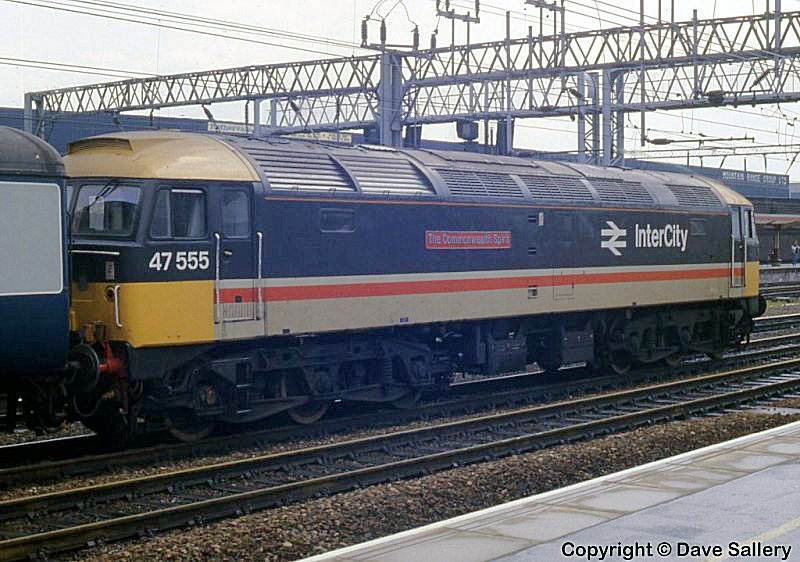
47 555, The Commonwealth Spirit Crewe, 19 May 1988. At the time this was a regular on Coast trains.
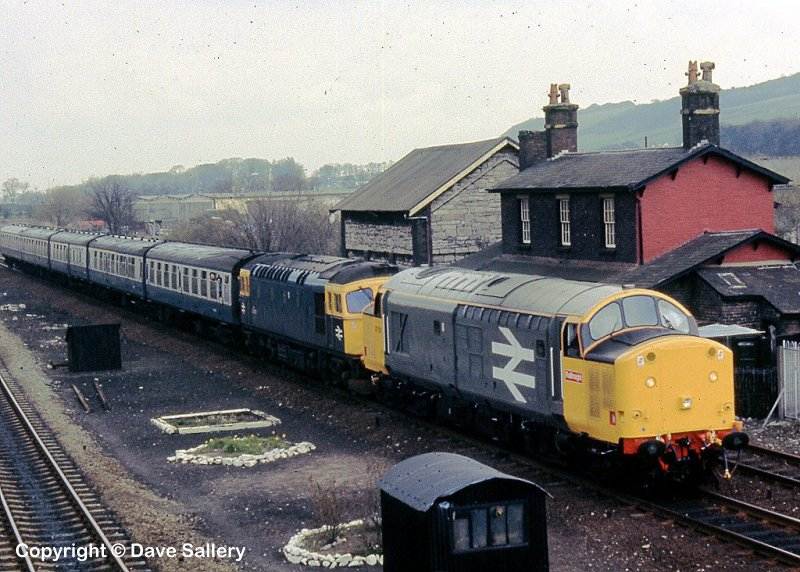
37 501 and 33 013 arriving at Prestatyn, 23 April 1986. The 37 was on test after rebuild at Crewe works - and is now with Rail Operations Group. having been re renamed Teesside Steelmaster and having spent a period as 37 601. 33 013 was not so lucky and was cut up at M C Metals Glasgow in June 1991. Instead of using old carriages as a load (see item above) 37 501 would be attached a Cardiff-bound train as far as Crewe.
The the building in the background were the original Prestatyn station buildings, and today have been part of a Shopping centre
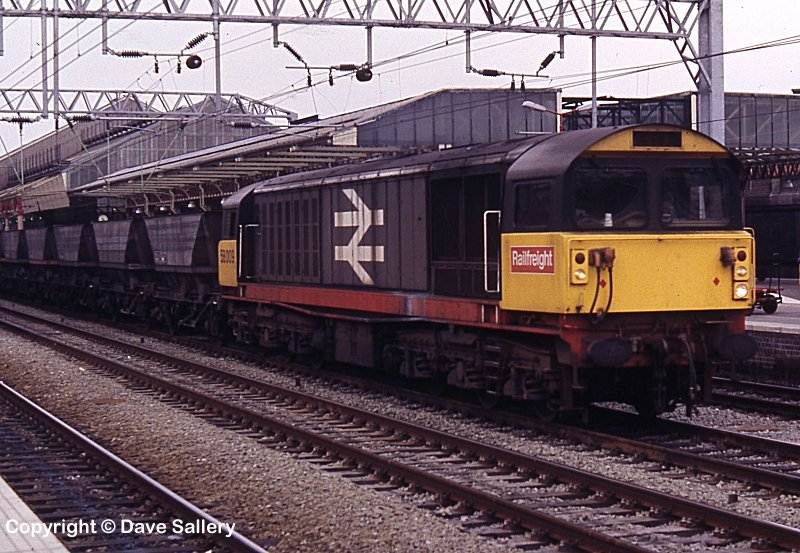
58 009 with empty 'Merry Go Round' Hoppers at Crewe, 12 September 1985. The train would have come from Garston docks from where coal was exported to Northern Ireland from the East Midlands.
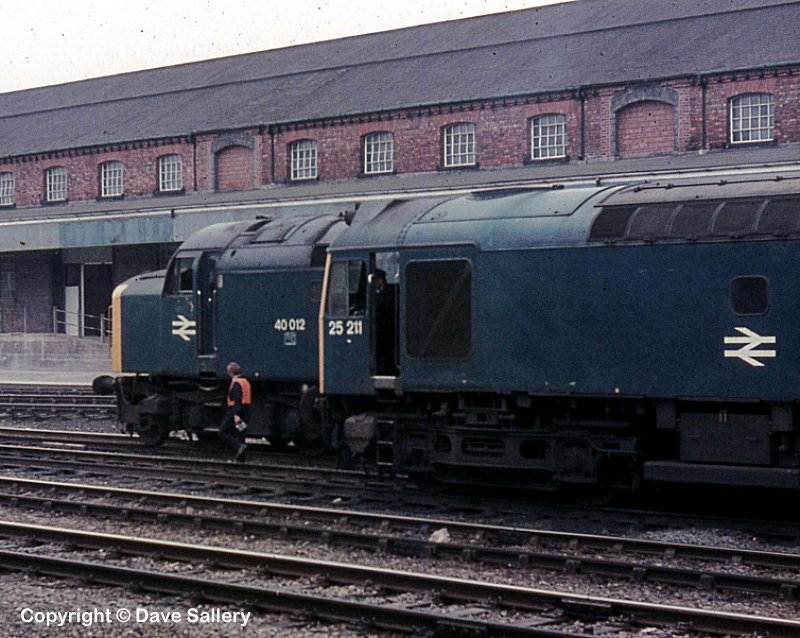
25 211 and 40 012 between duties in Chester yard, 9 July 1984. The warehouse was destroyed by fire in 2010, and the area is now a Housing estate. 40 012 is still in action, with the LSL company; 25 211 was scrapped in 1986
From Richard Snook's collection
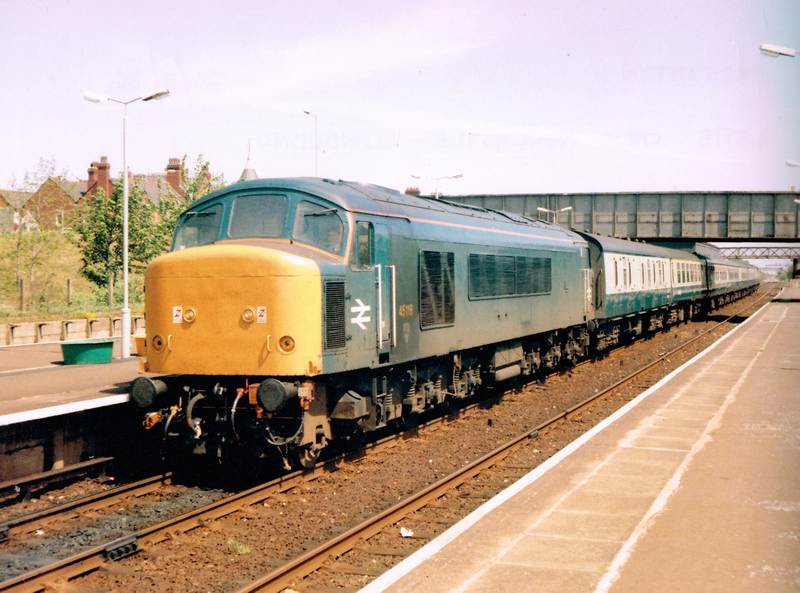
26 May 1986: 45 118 at Prestatyn with the 08:20 Newcastle - Llandudno. The name The Royal Artilleryman, and badge, applied in 1985, had been removed by this time, for 'safe keeping'. The loco was withdrawn in January 1987 due to a fire in its electrical system. It was saved for preservation, and after many ups and downs it was taken in hand by Locomotive Services and in early 2026 it ran a train on the main line again. For a detailed history read the document by the 15/1 preservation Society .
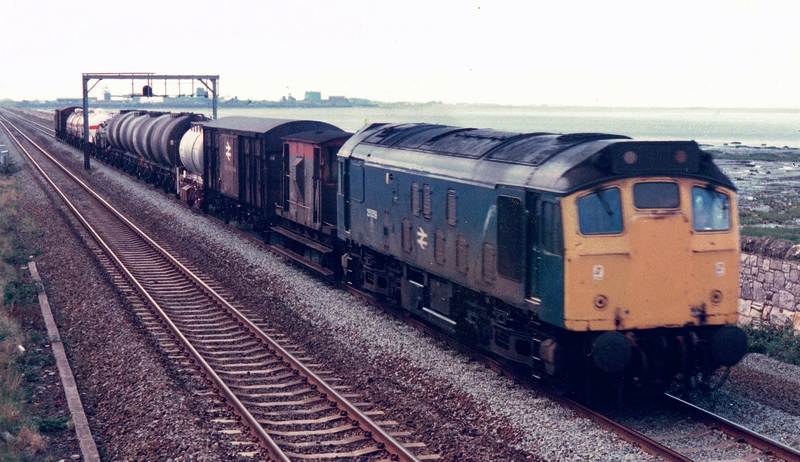
19 September 1986: Ffynonngroyw, and 25 059 with a long train of chemicals from the Octel factory at Ellesmere Port. Notice the second van, one of a batch of wagons designed for use carrying goods to the Continent, but they were rarely used, and often used as a barrier to protect the train crew of dangerous loads.
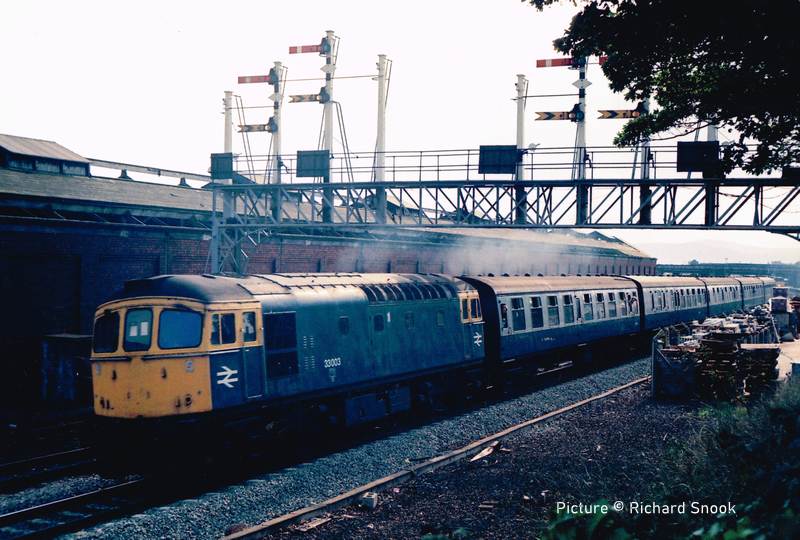
30 September 1986: Rhyl with loco 33 003 on 14:08 Holyhead- Cardiff . These workings were short-lived, just from 1985-6, and brought out the enthusiasts, as can see leaning out of the train. The building behind is a carriage shed; it stood in the area now stands the Matalan store and other buildings . It seems to have been demolished some time around the 90s. does anyone know the date?
Looking Back: 1972 part 2 - with David Pool
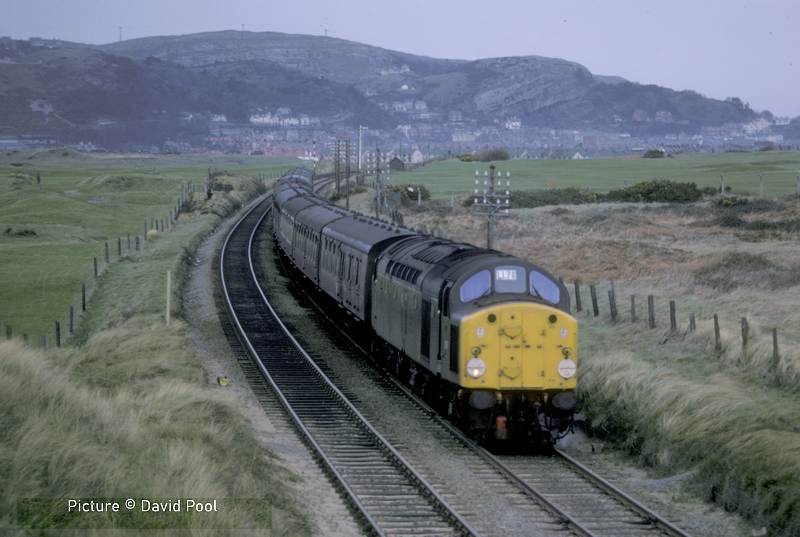
A
returning excursion to Longton had left Llandudno at
18:00 on 2 April
1972, and was approaching Deganwy with 217,
one of the earliest of the English Electric Type 4s.
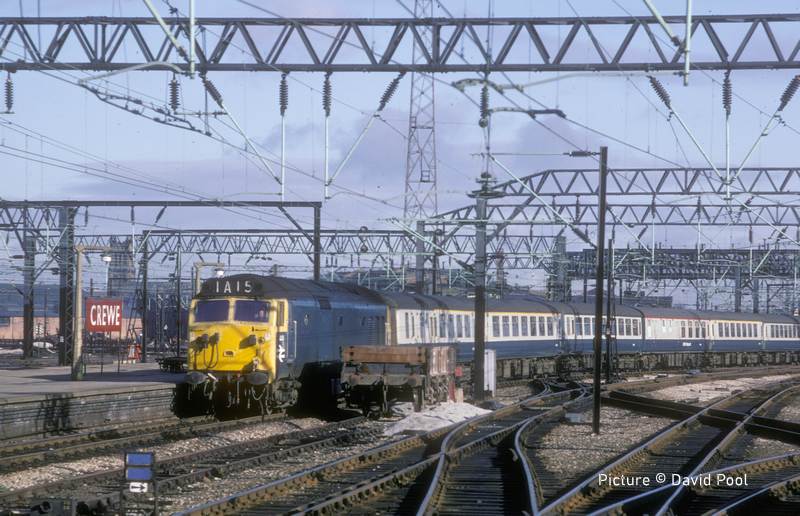
Visiting
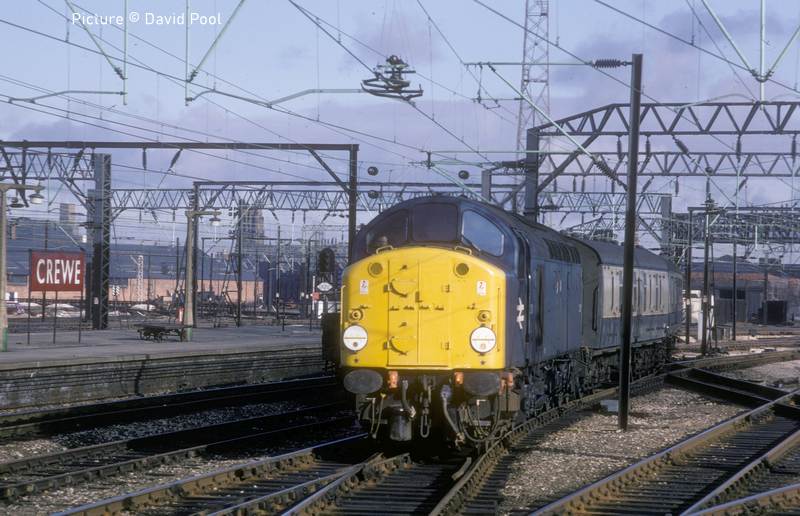
Crewe on 8 April 1972, my first shot was the Ulster
Express. This
had left Heysham at 0650 for Euston, with another
English Electric
locomotive 449. This was the last of what would become
the Class 50 locomotives. It
may be worth clarifying the background to these
locomotives, since
their family tree can be confusing. A prototype
locomotive with two
Napier Deltic marine type engines had been built in
1955. This was
DP1, which
was probably Development Prototype 1 or Diesel Prototype
1, and was
lettered DELTIC on the body. Meanwhile British Railways
was
operating various lower powered diesels, such as 10203
on the Southern Region.
The bogies and power train on the first
Type
4 (Class 40) locomotives were based on those on 10203,
and appeared in 1958. The
Class 40s were adequate for most trains, but the Deltic
power was
needed for the faster trains planned for the East Coast
Main Line. Another prototype was produced in 1962 with
an engine a little more
powerful than that in the Class 40s, being designated DP2. The
body shell was similar to that on DP1. More
locomotives based on the DP1
design were built, becoming known as the Deltics or
Class 55. The
engine in DP2
was then specified for a new class of diesels which
would have a flat
fronted body – these were the Class 50s, numbered 400
to 449 and
built in 1967 and 1968. Locomotive 449
was named Defiance
in 1978, then was temporarily fitted with regeared
bogies for trials
on freight trains, being renumbered 50
149. The trials were not
sufficiently
successful to warrant further conversions, and 449
regained its original
number 50
049. In Preservation
this locomotive
has appeared in a variety of liveries, such as GBRf dark
blue and BR
large logo blue, the latter being its current livery on
the Severn
Valley Railway.
The
next named train arriving at Crewe was the Emerald Isle
Express. This had left Holyhead at 06:34, also heading
for Euston. A Type 4
would be the usual motive power on the North Wales
Coast, on this
occasion 220. I thought at first the film had been
scratched immediately above the
locomotive, but looking more closely it appears to be
part of the
catenary. Can anyone suggest what this is?
I
then joined the Wirral Railway Circle’s Railtour to
Pwllheli
departing from Crewe at 09:10. This started with Class
24s 5080
and 5056,
but the latter failed and was replaced at Welshpool by 5062.
After a photo stop at Barmouth (shown on the notice
Board dated 26 May
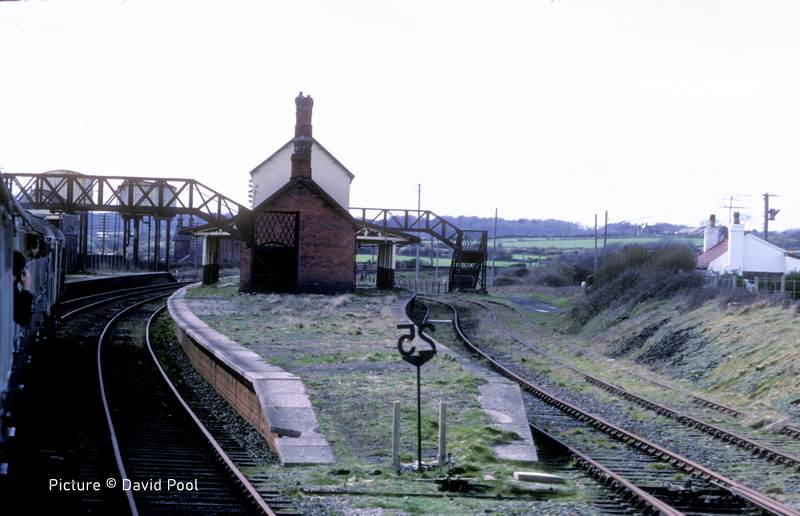
2020) we continued North. The location of my next shot
will not be
familiar to many of today’s photographers, and there is
little
visible today at Afon Wen.
My
final
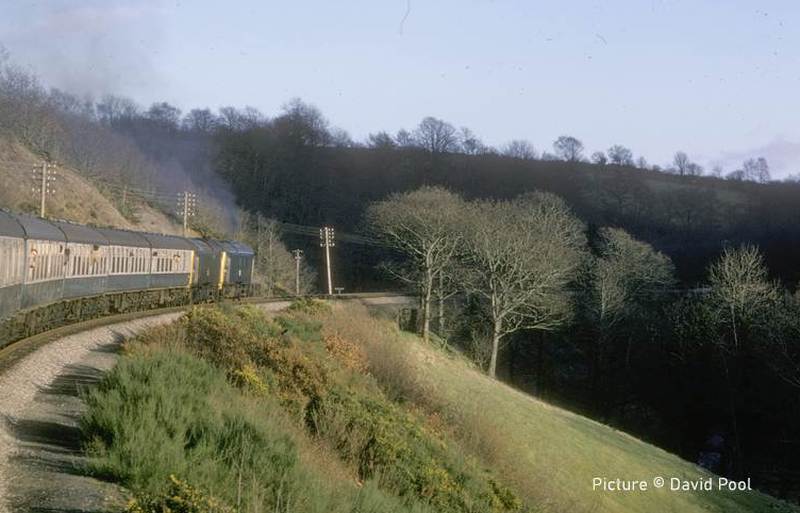
shot on the Railtour was on the climb to Talerddig. The
lighting was
superb, and the two 24s were working hard.
The
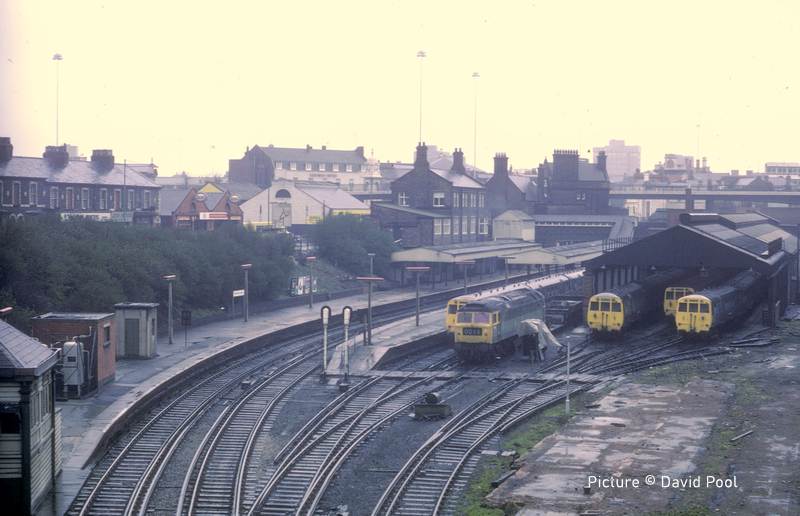
weather had changed on the following day, a Sunday. A BR
diesel
locomotive was not a common sight at a Wirral Electric
Depot, but
1841
(later 47 191)
was at Birkenhead Central.
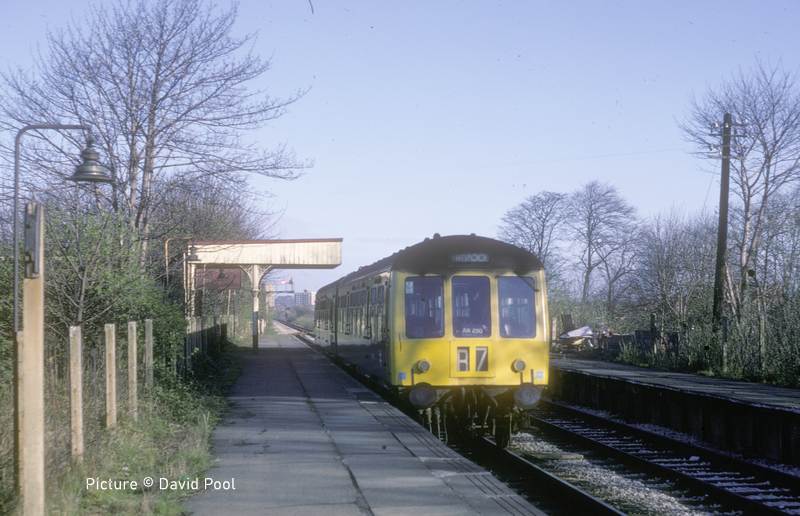
The
Gateacre branch finally closed on 15 April 1972. Getting
to
Liverpool City Centre from my home by train would
involve a mile walk
to Gateacre Station, then a half hour journey. The other
choice was
a bus stop about 100 yards from my house with buses
every 15 minutes
or so to the City Centre, which took 20 minutes. Getting
up early, I
was at Gateacre for the 08:15 departure, a Class 108
unit
M51417/M56213.
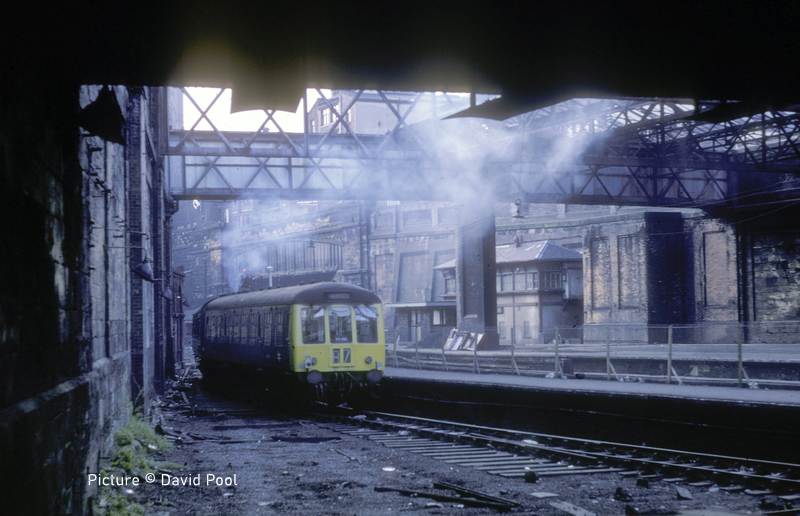
Photography at the remains of Liverpool Central Station was difficult, and my shot of the unit returning to Gateacre at 09:00 shows a scene of neglect. In fairness, the later extension of the line from Liverpool Central Low Level Station and the electrification to Hunts Cross is now a valuable part of the Merseyrail system. (dp3388).
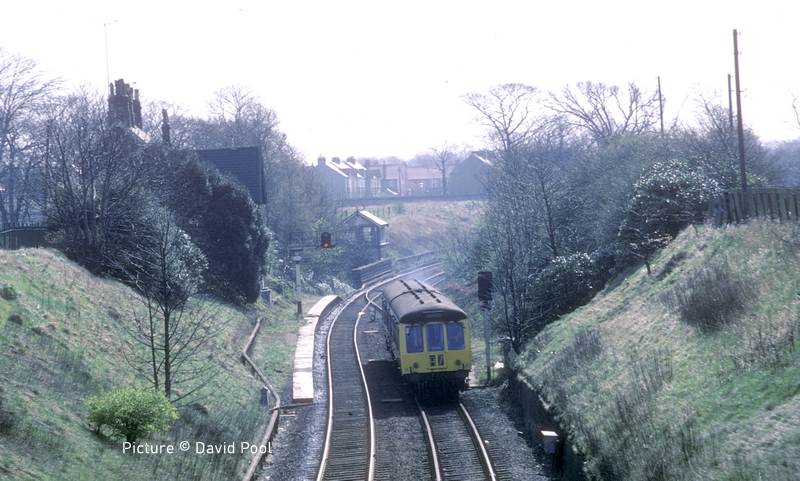
I
later photographed the Class 108 unit at Otterspool,
returning from
Gateacre. The station here had closed in 1951, and was
never
reopened.
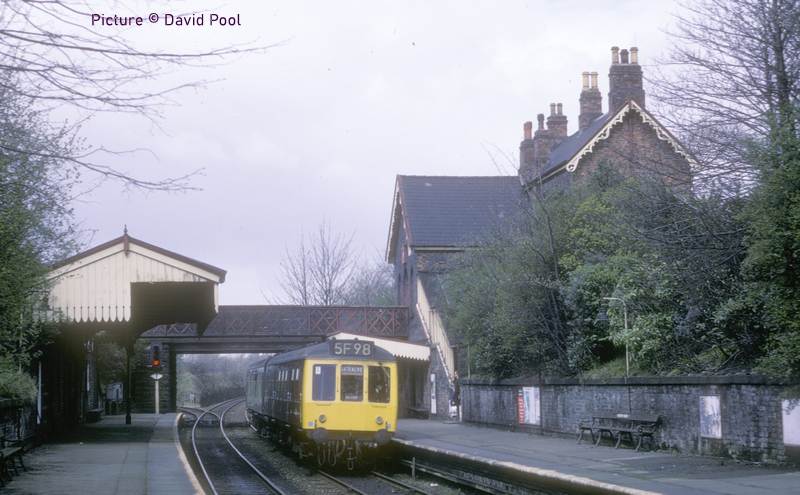
The
next station was Mersey Road, now known as Aigburth
Station, with the
11:00 from Liverpool Central arriving. The siding beyond
the bridge
is interesting, and I don’t remember seeing any wagons
there. It
could possibly have been used for the construction of
Otterspool
Promenade – any information would be welcome.