Last update December 2019
Note: all the former 'Voyager' names have now been removed by both companies, they are shown here out of interest.Avanti West Coast Fleet:
221 101 [Louis Bleriot]221 144 has been disbanded, its two power cars now kept as spares.
221 102 [John Cabot]
221 103 [Christopher Columbus]
221 104 [Sir John Franklin]
221 105 [William Baffin]
221 106 [Willem Barents]
221 107 [Sir Martin Frobisher]
221 108 Sir Ernest Shackleton]
221 109 [Marco Polo]
221 110 [James Cook]
221 111 [Roald Amundsen]
221 112 [Ferdinand Magellan]
221 113 [Sir Walter Raleigh]
221 114 [Sir Francis Drake]
221 115* [Polmadie Depot]
[originally Sir Francis Chichester]
221 116 [David Livingstone]
221 117 [The Wrekin Giant]
221 118 [Mungo Park]
221 142 Bombardier Voyager
221 143 Auguste Picard
Cross Country fleet:
221 119 [Amelia Earhart]
221 120 [Amy Johnson]
221 121 [Charles Darwin]
221 122 [Doctor Who]
221 123 [Henry Hudson]
221 124 [Charles Lindbergh]
221 125 [Henry the Navigator]
221 126 [Captain Robert Scott]
221 127 [Wright Brothers]
221 128 [Captain John Smith]
221 129 [George Vancouver]
221 130 [Michael Palin]
221 131 [Edgar Evans]
221 132 [William Speirs Bruce]
221 133 [Alexander Selkirk]
221 134 [Mary Kingsley]
221 135 [Donald Campbell]
221 136 [Yuri Gagarin]
221 137 [Mayflower Pilgrims]
221 138 [Thor Heyerdahl]
221 139 [Leif Eriksson]
221 140 [Vasco Da Gama]
221 141 [Amerigo Vespucci]
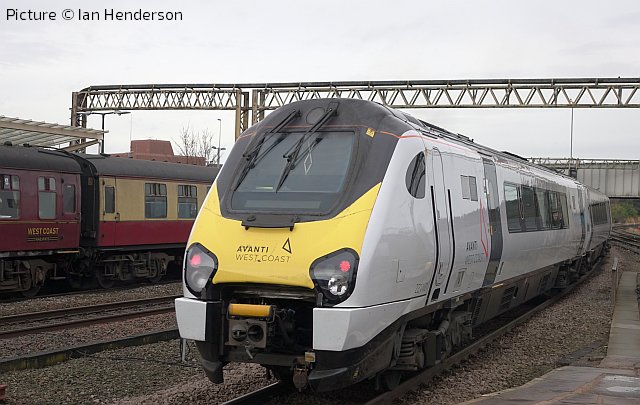
Class 221 are diesel-electric railcar sets built in 2001-2003 by Bombardier Transportation in Belgium, with some of the assembly work being done in England. They differ from the Class 220 'Voyagers' in that the 221s are equipped with tilting equipment offering up to six degrees of tilt to allow them to take curves faster without affecting passenger comfort.
They were all built for the Virgin Cross-Country fleet, but reorganisation of franchises, under which Virgin lost the Cross Country franchise, divided the Class 221 fleet in 2007 between Virgin West Coast and Arriva's CrossCountry operation. December 2019 saw a further change, when the West Coast franchise was transferred to Avanti West Coast, a joint operation by First Group and Italian national railway Trenitalia.
CrossCountry units are not seen on North Wales trains. The succesot companies are now are not using the name 'Voyager' and the 'explorer' names have been removed from all the trains.
221 114 - 118 were CrossCountry units for a few months until December 2008 when they returned to Virgin. (Oddly, their nameplates were included with others sold by Virgin at a charity auction.) All the non-tilting Class 220 types are with CrossCountry; the tilting equipment on the CrossCountry 221s has apparently been isolated.
The coach bodies, the engines and most of the equipment of the two types are the same, but the bogies are very different; the 220s have inside bearings which expose the whole of the wheel faces, whilst the 221s have a more traditional-looking outside-framed bogie. To aid identification by staff, the two types had different Virgin 'shield' logos on the nose: the 221s have a red background to the shields, and the 220s a silver background, but Cross Country and Avanti have removed the shields from their units.
The 221s as built featured an interesting naming theme, the trains being named after various 'voyaging personalities' with dark blue backgrounds to their plates (fixed to one of the intermediate coaches). Virgin have retained ownership of the plates when the trains passed to other companies, and a number have been auctioned for charity.
The fleet numbers of the units are marked low down on the corner of the driving ends and very hard to see when the trains are in service: best best is to note the name and refer to the table below; alternatively each coach of a 221 has a number of which the last two digits are the last two of the unit number plus 50, e.g. coach 60360 is part of 221 110. The 221 fleet is owned by Halifax Asset Finance, managed by Angel Trains, and leased to the operators.
There were 44 Class 221 trains built, numbered 221 101 to 221 144. 101 to 140 were five-car trains built for Virgin Cross Country, and 141 to 144 were four-car sets which were intended for use by Virgin West Coast on the London - North Wales service. However, things have not worked out like this.
All coaches are equipped with a Cummins QSK19 diesel engine of 560kW (750hp) at 1800rpm, powering a generator which supplies current to motors driving two axles per coach. Maximum speed is 125 miles per hour, and 1200 miles can be travelled between refuellings. A five car set provides 26 seats in First (originally 'Club') class and 224 in standard. All vehicles are air-conditioned and fitted with at-seat audio entertainment systems and power sockets for laptop computers and mobile phone charging.
The train formation as built was:
Standard Class with driving cab and reservable space for four bikes (coach F)
Standard Class with Shop/Buffet counter (D)
Standard Class (C)
Standard Class (B)
Club Class with pantry and driving cab(A).
In 2008 they were reformed and re-equipped in preparation for taking over North Wales 'business' services at the start of 2009.
The main change is to the 'shop' coach (D) was positioned second in the train, next to the first class coach (A), and has been fitted with new seating 'for use as standard or first class as required.' The 'shop' itself is at the end of the coach nearest to the three 'normal' standard class cars. Presumably the seating in coach D will become first-class on 'business' trains between North Wales and London which will be serving meals as the current Pendolinos do. The 'hybrid' seating is '2 + 2' layout, all but four of the seats are arranged round tables and match the windows.
The 'galley' in first-class coach A has been refitted with new equipment, and interior closed-circuit TV has been fitted throughout the train, as well as forward facing CCTV in the driving cabs as found in Arriva's 175s. The re-forming also required to changes to electrical arrangements, as the trains are set up for each coach's electrical supply to be fed from the adjacent one if necessary.
A further change in late 2010 was the disbandment of four-car unit 221 144, its two centre vehicles being used to strengthen the other two 4-car sets to 5-car, while the two power cars were stored as spares.
During 2014 all West Coast units underwent a programme of modifications, most obviously including the replacement of the front 'skirt' with a different version similar to that used in the East Midlands Trains Class 222 'Meridians', requring the unit number to be placed in a different position, higher and further back.