Transport for Wales
Class 150 fleet
150208   52208 57208
150213   52213 57213
150217   52217 57217
150227   52227 57227
150229   52229 57229
150230   52230 57230
150231   52231 57231
150235   52235 57235
150236   52236 57236
150237   52237 57237
150240   52240 57240
150241   52241 57241
150242 	 52242 57242
150245 	 52245 57245
150250   52250 57250
150251   52251 57251
150252   52252 57252
150253   52253 57253
150254   52254 57254
150255   52255 57255
150256   52256 57256
150257   52257 57257
150258   52258 57258
150259   52259 57259
150260 	 52260 57260
150262 	 52262 57262
150264 	 52264 57264
150267 	 52267 57267
150278   52278 57278
150279   52279 57279
150280   52280 57280
150281   52281 57281
150282 	 52282 57282
150283   52283 57283
150284   52284 57284
150285   52285 57285
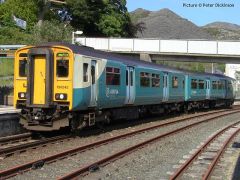
150 242 (Peter Dickinson)
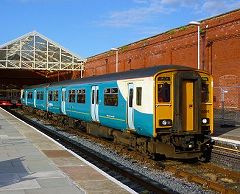
150 256 (Ken Robinson)
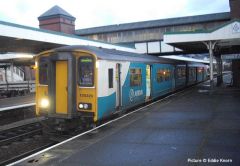
150 229 (Eddie Knorn)
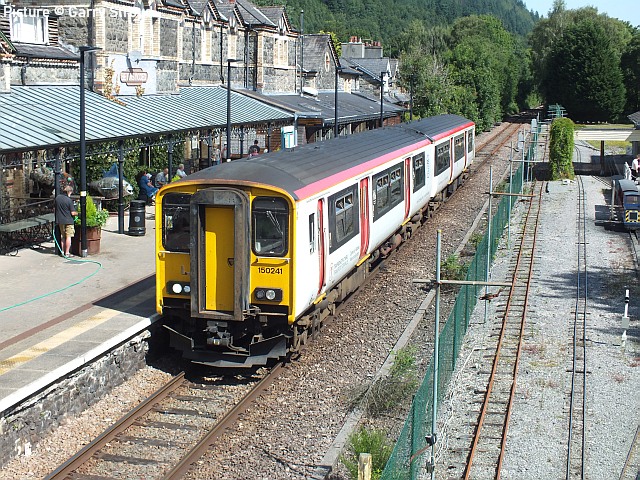
150 241 at Betws-y-Coed (Garry Stroud)
Technical Specification | Operations | Livery | Historical Notes
A 2-car Class 150 diesel railcar set comprises two steel-bodied driving motor cars, each 19.74 metres long, built in 1986-87 by the York works of BREL to a design based on the Mk3 hauled coach bodyshell. One vehicle of each pair, the 52xxx vehicle, has a toilet compartment at its inner end.
The oldest series, Class 150/1, have no gangway connections in the cab ends, and hand-operated crew doors, whereas the later 150/2 series have corridor connections and powered doors for the crew. All TfW units are 150/2s.
Each car has one Cummins NT855R5 diesel engine of 213 kW (285 HP) driving both axles of the bogie at the non-driving end through a Voith hydraulic transmission and Gmeinder final drives, identical to the drive equipment of Class 153 and 156. Maximum speed is 75 mph. Air suspension units are provided for each bogie, the three-step air-operated brakes have a variable load feature, and public address equipment is fitted.
Class 150 units have BSI (Bergische Stahl Industrie) outer couplers, and can work in multiple with Classes 142, 150, 153 and 158.
There were 85 two-car 150/2 units built; three coaches have been withdrawn due to accident damage. Other users still using the type in 2021 are Northern - whose trains can be seen at Chester - and Great Western.
Operations
Arriva Trains Wales started life in 2003 with just five units of the 150/2 type which came from the Cardiff Railway Company, which had refurbished them with 2 + 2 seating in place of the original cramped 3 + 2 type. From 2005, many more 150/2s arrived at Cardiff depot, transferred from other companies. These had old-style 3+2 seats when they arrived, but were refurbished to the same standard as the others and repainted in Arriva standard livery. These units enabled the Wrexham - Bidston service, and the Conwy Valley service in summer, to be worked by 2-car 150s instead of the single-car 153s previously used.
The majority of Class 150 workings are in the South Wales area, the Shrewsbury - Lllaneli route, and the Crewe - Shrewsbury stopping service, but from time to time they can often be seen substituting for unavailable Class 158 or 175 on longer-distance expresses such as Manchester - Cardiff and Holyhead - Cardiff, despite having a lower maximum speed that those types. They cannot be used on the Cambrian lines to Aberystwyth and Pwllheli as they are not fitted for the ERTMS signalling used there.
For a while, from 2008, six sets, in full Arriva Trains Wales livery, were 'temporarily' in use by First Great Western in the West of England, although officially part of the ATW fleet, and there have been loans to other companies from time to time.
All the Arriva Class 150s passed to Transport for Wales in 2018, and the remains unaltered in 2021, although they are destined for replacement by new stock.
Livery
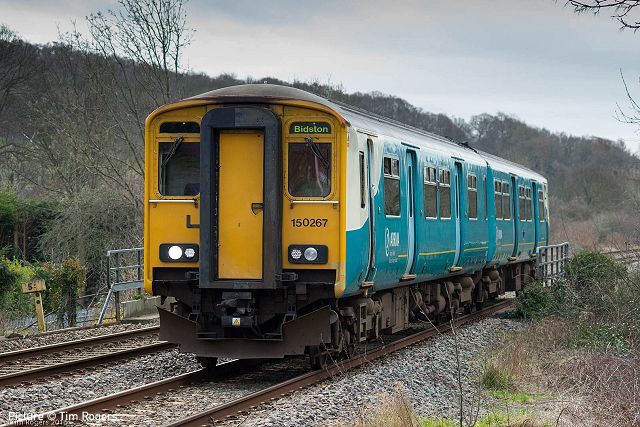
Arriva Trains Wales, following their takeover of the franchise, repainted all their Class 150 units in the standard Arriva branding (above, picture by Tim Rogers) based on the Arriva group bus livery. Later, overhauled units received the 'Welsh Government' blue scheme based on the livery chosen for the loco-hauled express coaches. At the time of writing (2021) a number of Class 150s have seen application of the red and grey Transport for Wales livery.
Historical notes
By the early 1980s no new diesel railcars for local services had been built for British Rail in 20 years, and replacement was becoming matter of urgency. From 1983 onwards a series of 4-wheeled vehicles was built (Class 142) but these supposedly cheap trains soon showed their inadequacy. Two prototype diesel-electric trains (class 210) based on the Mk 3 coach were built, but these were thought too expensive. BREL and Metro-Cammell were asked in early 1983 to build prototypes diesel-hydraulic trains suitable for both local and long-distance services, and BREL produced two Class 150 sets based on the Class 455 electric trains then in quantity production for suburban services south of London. Metro-Cammell's version, the Class 151, was delayed into service for various reasons, with the result that rather than the intended comparative testing, 50 two-car Class 150s were ordered, and 37 of these were ready to take over all workings based at Derby Etches Park depot on 20 January 1986.
The production trains differed from the prototypes in having just two coaches per unit instead of three, a result of someone in Whitehall arbitrarily deciding that two new cars would be sufficient to replace three of the old ones. The two three-car prototype sets, 150 001 and 150 002, are still in traffic in 2021 with Northern; their centre vehicles are the only Class 150 cars without driving cabs.
Built in 1987 on the Class 150 production line was the unique track-recording unit, 950 001, which is used by Network Rail for track-assessment duties, especially on lines where locomotive-hauled trains are not allowed. It looks like a 150/1 with fewer doors and windows, and carries video camera and other equipment on the ends.
A second order for 85 two-car units, which became Class 150/2, was placed in 1986, and delivery began before the end of that year. Some of these second-wave units were first used to replace locomotive-hauled trains on the Trans-Pennine expresses, a duty for which their high-density seating layout was far from suitable; by the time they were moved to local services elsewhere a couple of years later, they already seemed travel-weary. The original seats, known as the 'Ashbourne' type, fell apart on a regular basis and had to be rebuilt, the floors rotted, and various other matters needed attention, although they did not suffer from the major problems found in some other units.
In 2021 the 150s continue operating well past their 30th birthday, and have shown themselves to be very reliable mechanically, although the interiors are not up to modern standards. They remain divided between TfW, Northern and Great Western; TfW have a plan to replace them with new stock and electrification on the Great Western line has allowed transfer of some of their units to Northern, who have them for continued use well into the 2020s or beyond.